The Water Network research ...
Published by Water Network Research, Official research team of The Water Network
The Water Network research team has consolidated an answer to the above question.
Further input from members is welcome and appreciated.
What is pH in drinking water?
The pH level of your drinking water reflects how acidic it is. pH stands for “potential of hydrogen,” referring to the amount of hydrogen found in a substance (in this case, water). pH is measured on a scale that runs from 0 to 14. Seven is neutral, meaning there is a balance between acid and alkalinity. A measurement below 7 means acid is present and a measurement above 7 is basic (or alkaline).
What are the health effects of pH?
The U.S. Environmental Protection Agency (EPA) does not regulate the pH level in drinking water. It is classified as a secondary drinking water contaminant whose impact is considered aesthetic. However, the EPA recommends that public water systems maintain pH levels of between 6.5 and 8.5, a good guide for individual well owners. Water with a low pH can be acidic, naturally soft and corrosive.
Acidic water can leach metals from pipes and fixtures, such as copper, lead and zinc. It can also damage metal pipes and cause aesthetic problems, such as a metallic or sour taste, laundry staining or blue-green stains in sinks and drains. Water with a low pH may contain metals in addition to the before-mentioned copper, lead and zinc.
Drinking water with a pH level above 8.5 indicates that a high level of alkalinity minerals are present. High alkalinity does not pose a health risk, but can cause aesthetic problems, such as an alkali taste to the water that makes coffee taste bitter; scale build-up in plumbing; and lowered efficiency of electric water heaters.
But some research site says that:
People have a higher tolerance for pH levels ( drinkable levels range from 4-11 with minimal gastrointestinal irritation), there are still concerns. pH higher than 11 and lower than 4 causes skin and eye irritation. pH bellow 2.5 causes irreversible skin damage and organ linings.
pH adjustment systems:
There are two primary types of system design for pH adjustments – continuous and batch.
Continuous flow
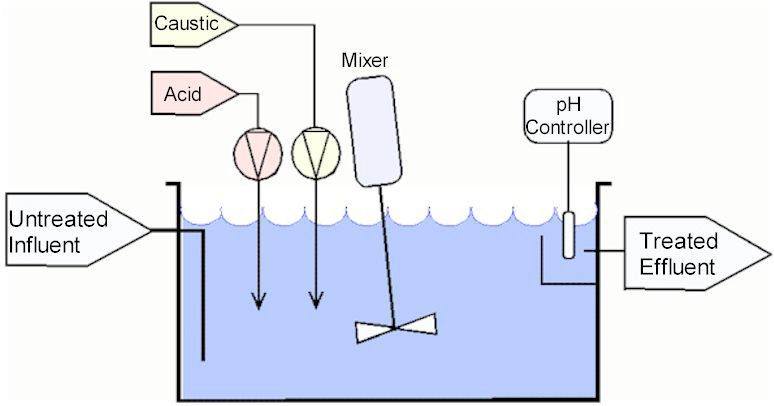 Diagram 1: Continuous flow system.
Source: phadjustment. com
The tank is constantly full – the amount of influent entering it equal to the treated effluent exiting the tank.
The advantage of this system is that can handle relatively high flows. However, it is not certain that the effluent will always be in range.
Batch
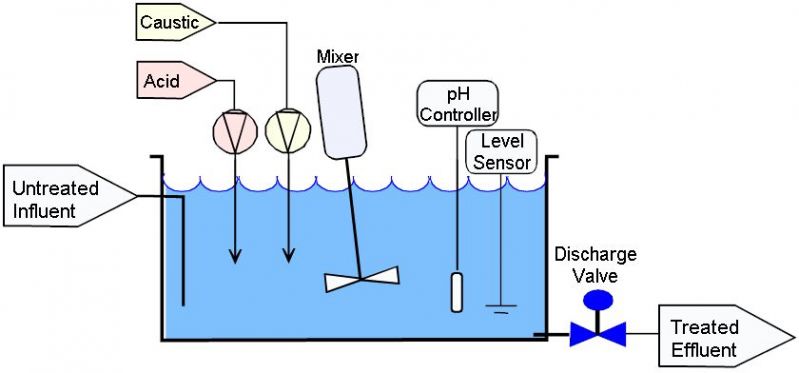 Diagram 2: Batch adjustment system
Source: phadjustment. com
The batch has a fixed water volume, which is discharged only after fulfilling the criteria.
The influent enters the tank anywhere convenient and exits due to gravity near the bottom, where the port is located.
The batch volume is treated in one cycle.
** The systems shown here are simplified.
pH adjusting methods:
Raising the pH | Lowering the pH |
Neutralizing filters | Acid injections |
MgO beads | CO2 |
Soda ash/ sodium hydroxide injections |
|
Neutralizing filters
Neutralizing filters are used if drinking water is acidic.
The pH is increased by the addition of the neutralizing material.
It is important to highlight that the water hardness may increase.
(Water hardness is the amount of dissolved calcium and magnesium in the water - dissolved bicarbonate minerals - calcium bicarbonate and magnesium bicarbonate.)
Neutralizing filters are point-of-entry devices.
Water with pH greater than 6 is treated with calcium carbonate ( limestone) and water with the pH below 6 is treated with the synthetic magnesium oxide.
Untreated water passes through a filter filled with either calcium carbonate or a synthetic magnesium oxide medium and the material dissolves in the water therefore raising the pH level.
The flow rate should not the greater than 2 l/s·m2. The bed should be deep enough to provide sufficient contact time.
The material in the neutralizing filter need refilling and regular backwaching.
If cartridge filters, that retain solids from passing through, are installed before the neutralizing filters, the neutralizing filters will last longer.
After the neutralizing filter a water softener can be added to regulate the water hardness.
The neutralizing filter may result in pressure loss, since the water passes through the finely ground neutralizing material.
The corrosion of the pressure tank and the well pump may occur since the neutralizing filters are installed after the pressure tank.
In case of a high flow rate, liquid injection systems are a better solution.
Magnesium oxide beads in combination
Prill MgO beads are used when the water pH needs to be rasied.
They should be used after reverse osmosis.
Osmosis is a spontaneous movement of the molecules in the solvent through a semi- permeable membrane. The molecules tend to “ go” to the in that direction that will equalize the concentrations of the two sides. Reverse osmosis is a process in which the particles move in the opposite direction than in natural osmosis. The contaminated fluid passes through the membrane and the suspended particles are separated from the liquid. For this process, pressure is needed – the hydrostatic pressure needs to be greater than the osmotic pressure.
Prilly Pure Water Beads raise and balance pH levels of the water to 8,7 without any chemicals.
The beads are made from magnesium oxide which is produced from naturally occurring salts of magnesium found in rich brine deposits located approximately 2, 500 feet below ground. The resulting magnesium oxide is ‘ prilled’ into small, hard pellets by a high temperature firing process which turns them into small ceramic-like pellets.
In addition to adjusting the pH, the beads lower the surface tension of water, remove toxins and pull out heavy metals from water.
Prilly Pure Water Beads last forever and never need to be replaced.
Injection systems:
I Soda ash/sodium hydroxide injection
Soda ash/ sodium hydroxide injections are used if the water is acidic.
When injected into a water system, soda ash (sodium carbonate) and sodium hydroxide raise the pH of water.
Injection systems are a point-of-entry system.
Soda ash or sodium hydroxide solution are injected in the water by a corrosion- resistant chemical feed pump.
The injections are installed before the pressure tank so that the tank ant plumbing systems are protected from corrosion.
Dual treatment is used if the water needs to be disinfected, in addition to being neutralized. A chlorine solution is added with the neutralizing chemical.
With the injection systems water with low pH can be effectively treated – as low as 4.
The chemical storage tanks need to be refilled occasionally.
II Acid injection
Acid injection is used for water with a high pH.
Water with a higher pH can have a soda- like taste that is eliminated with this treatment and the chlorination is improved.
Acid injection is a point-of- entry system.
Acid injection reduces pipe corrosion, since water with the pH above 9 corrodes brass, copper, zinc, aluminum and iron.
A solution of acetic acid is injected into water. Usually white vinegar is used, as it is the cheapest, but citric acid and alum are also an option, as well as more hazardous weak solutions of hydrochloric acid or sulfuric acid if the pH is above 11.
The chemicals need to be refilled occasionally, while wearing the protective goggles, gloves and clothing.
Carbon dioxide
Carbon dioxide is used to reduce pH in alkaline water.
Carbon dioxide, CO2, is a colorless and odorless gas. It is a chemical compound composed of a carbon atom covalently double bonded to two oxygen atoms.
It is used as a pretreatment and sulfuric acid is added in the second step. The main purpose of this secondary acidification is to reduce the bicarbonate content and avoid calcium carbonate precipitation.
Carbon dioxide does not corrode the pipes and the equipment.
It was gives better control of pH than sulfuric acid. It shows self- buffering when reaching neutral pH levels. The self-buffering enables precise end-point control eliminating the danger of lowering the pH too much.
It can be utilized via a completely automated system.
Documents on TWN about pH and drinking water standards:
- WHO guidelines for drinking- water quality
- WHO pH in drinking-water
- EPA drinking water standards and health advisories table
- pH Control in WTP by the Addition of CO2
- Drinking Water Treatment - pH Adjustment
- pH Requirements of Freshwater Aquatic Life
- What is pH and How is it Measured?
- pH Theory and Practice
- The Theory of pH Measurement