The Water Network research ...
Published by Water Network Research, Official research team of The Water Network
The Water Network research team has consolidated an answer to the above question.
Further input from members is welcome and appreciated.
Total Dissolved Solids (TDS) are all the minerals, salts, metals and ions (cations and anions) in the water.
Pure water is a universal solvent – it easily dissolves the inorganic salts (Ca, Mg, Na, bicarbonates, chlorides and sulphates) and some of the organic matter, hence the dissolved solids in water.
TDS in water has different origins - natural sources (leaves, silt, plankton), sewage, urban run-off, industrial wastewater, and chemicals used in the water treatment process.
They also come from rocks and air that contain certain minerals.
Another source of TDS are the metals water picks up while going through pipes while being distributed.
TDS is directly related to the purity of water and the quality of water purification systems and affects everything that consumes, lives in, or uses water.
TDS concentration is a secondary drinking water standard.
Therefore, elevated levels are not a health hazard, but the water has greater hardness, may create deposits and be corrosive, water may be coloured and have a salty and brackish taste.
By the EPA standards TDS should not exceed 500 mg/l.
By the WHO standards TDS in water classify as following:
Level of TDS [mg/l] | Rating |
Less than 300 | Excellent |
300 - 600 | Good |
600 - 900 | Fair |
900 - 1,200 | Poor |
Above 1,200 | Unacceptable |
For comparison, it is useful to state that most aquatic ecosystems with different fish fauna tolerate TDS levels of 1000 mg/l.
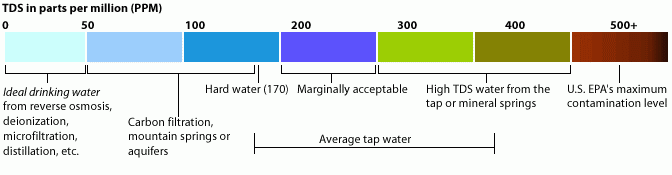
Diagram 1: TDS in ppm
Source: tdsmeter.com/what-is#what
Treating TDS depends on which solids are dissolved in the water:
- If TSD are calcium, magnesium or iron a water softener should be used.
- If concentrations of sodium, chloride, or potassium are elevated reverse osmosis should be used as a water treatment.
- For high to iron, manganese, arsenic concentrations or total hardness in general, other methods should be used.
* TWN Team has written a detailed answer on how to remove As from drinking water. Find it here.
* Read about total dissolved solids removal here.
Electrolysis
Electrolysis is a technique which uses direct electric current to initialize a reaction that wouldn’t otherwise occur on its own.
The electric current passes through a ionic substance (conducts electricity) which is molten or dissolved in a solvent.
The voltage needed for the reaction to occur is the decomposition potential.
When the electrodes are put in the ionic substance and the charge is released, the decomposition potential is passed through the ions which are attracted to the electrode of the opposite charge. On the anodes, the ions are made into molecules and atoms.
Electrolysis decomposes the Total Dissolved Solids (TDS) into cationic (positive ions) and anionic (negative) from as the current flows through the cathode (negative) and anode (positive). Cations are attracted by the cathode and anions by the anode.
Reactions occur on the electrodes - reduction on the cathode and oxidation on the anode.
Reduction is a chemical reaction in which the oxidation state of the atom is changed - electrons are gained and the oxidation state is decreased.
Oxidation is a chemical reaction which involves the electron transfer process as the electron is stripped, lost and the oxidation state is increased.
If more than one reaction is possible, the reaction which needs the least energy will occur.
How the electrolysis is used to treat TDS depend on the type of TDS.
Electrolysis is not used to treat water hardness.
However, the document “Water Hardness Removal for Industrial Use: Application of the Electrolysis Process” may be useful to read. It says about the production of primary coagulant during electrolysis improved flotation of both calcite: calcium carbonate, CaCO3, and magnesium hydroxide, Mg(OH)2.
Sulfur water
Sulfur water is caused by hydrogen sulfide which gives water the rotten-egg odor.
- Most people can smell hydrogen sulfide in water with a concentration of as little as 0.5 parts per million (ppm).
- Waters with concentrations from 0.5 to 1 ppm smell “musty” or “swampy.”
- Concentrations greater than 1 ppm smell like “rotten eggs” and are corrosive to plumbing.
To deal with sulfur water, it is useful to first establish why it is there in the first place:
1. Odor only in hot water:
If the stench occurs only in hot water the source is probably a reaction between an anode rod in the water heater and naturally occurring sulfate ions in the water.
The anode rod is made from magnesium or aluminium and the Mg one is more likely to cause the odor so replacing it with the aluminium rod is the first step to the solution. If the odor still occurs, there are two possible solutions – removing the anode rode completely or removing the sulfate ions.
Since the anode rod is protects the water heater tank from corrosion, removing the rod could shorten its life. However, corrosion inhibitors can prevent this.
Sulfate can be removed with a dealkalizer (removes alkalinity ions from water).
2. Odor in the cold water which goes away after water flows:
The source is most probably sulfare-reducing bacteria (SRB). They are not pathogenic but they cause an unpleasant odor by “breathing in” sulfate ions and “breathing out” hydrogen sulfide.
If there is no flow, the odor will occur and decrease as the water flows.
SRB are treated with shock chlorination of the entire system (chlorine stays in the system for several hours) but if this doesn’t eliminate the odor, continuous chlorination may be necessary.
3. Odor in both hot and cold water which doesn’t decrease with the flow:
This is caused by hydrogen sulfide from the aquifer source. Hydrogen sulfide is a gas formed by the decay of organic matter.
The treatment depends on the level of hydrogen sulfide and other contaminants, but also the flow rate and daily water usage.
Hydrogen sulfide is not a regulated drinking water standard since it is considered a nuisance and has no health risks for humans.
Water with such high concentrations that would pose a risk is not palatable.
0.5 mg/l gives water a taste and rotten egg smell.
Treatment usually relies on the oxidation of hydrogen sulfide gas into elemental sulfur.
- If hydrogen sulfide concentrations are above 6 mg/l chlorination is recommended.
- If hydrogen sulfide concentrations do not exceed 6 mg/l and water pH is above 6.8 an oxidizing filter, such as manganese greensand, is recommended.
Chlorination
Continuous chlorination is a common method for hydrogen sulfide treatment.
Chlorine kills the bacteria so it is a typical water treatment method.
Chlorine is usually administered as sodium hypochlorite and reacts with sulfide, hydrogen sulfide, and bisulfide forming compounds which do not cause bad taste or odor in water.
It is recommended to add 2 mg/l of chlorine for every 1 mg/l od hydrogen sulfide.
Chlorine is supposed to be added before the mixing tank and the water should have 20 minutes to get in contact with it in a sufficient storage space.
After this treatment, the water should pass through a depth filter or an activated carbon filter, to remove the remaining sulfur or excess chlorine.
Chlorination systems come in pellet-drops or liquid-chemical feed.
Chlorination systems may be costly are the constant chemicals addition is required and the system needs to be maintained regularly.
Manganese greensand
Manganese greensand is used as a hydrogen sulfide treatment method if its concentration is less than 5 mg/l.
Hydrogen sulfide gas is oxidized to solid sulfur particles, which get filtered, by special coating on a manganese greensand filter. Prechlorination is recommended.
The greensand should periodically be regenerated or recoated with potassium permanganate.
Manganese greensand comes in a natural and synthetic form. They have the same efficiency but the synthetic requires less backwash water and softens the water .
Aeration
Aeration is physical removal of hydrogen sulfide by agitating the water and stripping the hydrogen sulfide in a container.
Its greatest effect is achieved when hydrogen sulfide concentrations do not exceed 2 mg/l.
Air is introduced into water with an air compressor or blower.
Ventilation is required.
Aeration doesn’t require any chemicals and is not too expensive.
If hydrogen sulfide is oxidized to sulfide, bisulfide or solid sulfur particles which need to be filtered.
Ozone
Ozone oxidizes sulfides to solid sulfur and breaks down the slime produced by sulfur bacteria.
Ozone can treat high sulfide levels efficiently.
To remove hydrogen sulfide as a gas, ventilation is required.
Prefiltration is recommended and postfiltration is maybe necessary for the removal of oxidized solids.
Catalytic carbon
Catalytic carbon is activated carbon with a modified carbon surface.
Activated carbon is only effective in removing low concentrations of hydrogen sulfide and needs to be replaced once the filter is saturated.
Catalytic carbon has the ability to promote or catalyze chemical reactions, along with adsorption.
Catalytic carbon adsorbs sulfides and, with the presence of dissolved oxygen (minimum 0.4 mg/l), oxidizes them and converts to no objectionable compounds.
It doesn’t require any chemicals.
Ion exchange
Ion exchange is a physical- chemical process in which ions are swapped between a solution phase and solid resin phase. The process is named due to some ions being trapped and others released.
There are two types of ion exchange: cation exchange water softeners and anion exchange units.
For hydrogen sulfide, the anion exchange resin column is recharged with sodium chloride, and then chloride replaces sulfide.
Low water flow is a disadvantage along with elevated chloride levels. Moreover, anion exchange lowers the water pH making it corrosive.
Related questions:
- What is the best range for TDS in potable water?
- How to reduce TDS level in golf course irrigation water?
Additional resources:
WHO Guidelines for drinking-water quality
EPA drinking water standards and health advisories table
Hydrogen Sulfide in Household Drinking Water
Your Household Water Quality: Hydrogen Sulfide And Sulfate
Water Hardness Removal for Industrial Use: Application of the Electrolysis Process
Read more related content on total dissolved solids (TDS) here.