The Water Network research ...
Published by Water Network Research, Official research team of The Water Network
The Water Network research team has consolidated an answer to the above question.
Further input from members is welcome and appreciated.
Lead in water often comes from corrosion of pipes which happens mostly due to an acidic environment.
It is recommended to adjust the pH levels at point of use (POU). When the pH is increased the water will be less corrosive and this may be sufficient for lead levels to return to acceptable limits and this may eliminate the need for any further treatment.
As a cheap solution for pH adjustments, we suggest Magnesium oxide beads.
Read about other pH adjustment methods here .
Lead has a high affinity towards resin since it has high molecular weight and a valence of 2+.
Lead will come in place of the most charged metal ions in the resin and will not strip from it easily even when the salts or strong acids added.
If water pH is above 7, lead may be precipitated in a non-ionic colloidal form which cannot be removed by ion exchange and must be physically filtered.
EPA has set a primary drinking standard for lead of 0.015 ppm.
Magnesium oxide beads
Prill MgO beads are used when the water pH needs to be rasied.
They should be used after reverse osmosis.
Osmosis is a spontaneous movement of the molecules in the solvent through a semi- permeable membrane. The molecules tend to “ go” to the in that direction that will equalize the concentrations of the two sides. Reverse osmosis is a process in which the particles move in the opposite direction than in natural osmosis. The contaminated fluid passes through the membrane and the suspended particles are separated from the liquid. For this process, pressure is needed – the hydrostatic pressure needs to be greater than the osmotic pressure.
Prilly Pure Water Beads raise and balance pH levels of the water to 8,7 without any chemicals.
The beads are made from magnesium oxide which is produced from naturally occurring salts of magnesium found in rich brine deposits located approximately 2, 500 feet below ground. The resulting magnesium oxide is ‘ prilled’ into small, hard pellets by a high temperature firing process which turns them into small ceramic-like pellets.
In addition to adjusting the pH, the beads lower the surface tension of water, remove toxins and pull out heavy metals from water.
Prilly Pure Water Beads last forever and never need to be replaced.
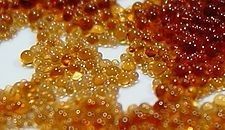 Ion exchange
Ion exchange is a physical- chemical process in which ions are swapped between a solution phase and solid resin phase.
Ion exchange resins are ion exchange polymers that are insoluble. They form small beads that are porous (water can pass through them). That way they provide a large surface area.
The process is named due to some ions being trapped and others released.
Ion exchange is also used for water softening.
Ion-exchange resins are used to replace the magnesium and calcium ions in hard water with sodium ions.
Fresh resin contains sodium ions at its active sites. When in contact with a solution containing magnesium and calcium ions (but a low concentration of sodium ions), the magnesium and calcium ions preferentially migrate out of solution to the active sites on the resin, being replaced in solution by sodium ions.
This process reaches equilibrium with a much lower concentration of magnesium and calcium ions in solution than was started with.
These methods should be combined with some of the following methods for bacteria and viruses removal include:
Chlorine
One of the most reliable treatments is Chlorine. It kills microbes and prevents new contamination long after it is added.
Chlorine is a highly efficient disinfectant.
Chlorine is a gas at atmospheric pressure but turns liquid under pressure. It is transformed and applied as a liquid.
It is a strong oxidizing agent and has disinfectant abilities due to oxidation of organic molecules.
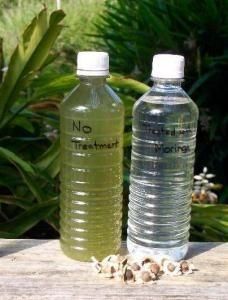 Moringa Oleifera
The Moringa Oleifera tree grows in tropical and subtropical regions.
It needs six months to reach fruition and is used in many areas as a food source. The seedpods, seeds, leaves, roots and flowers are all edible and nutritious.
Moringa Oleifera trees are widely present in Africa, the Middle East and the Indian subcontinent.
It is a fast growing (4.6 meters/year) crop tree that does well in the equator belt climates with non-soggy soils.
The tree's seed grow in pods. Dried, hulled, and ground seeds have a significant ability to reduce the suspended solids in extremely turbid waters.
Dried beans and seeds can be stored for a long time.
The shelled seeds provide much higher turbidity removal than the non-shelled ones.
Moringa Oleifera is a coagulant and an antimicrobial agent.
When adsorbed onto sand, a protein in dried and ground seeds, has excellent results in removing total suspended solids (TSS) and killing coliform bacteria.
A positively- charged protein called the Moringa Oleifera Cationic Protein (MOCP) is responsible for the excellent water- clarifying ability of the seeds.
When the seeds are crushed and added to water, this protein will kill the microbial organisms and cause them to clump together and settle at the bottom.
Moringa Oleifera seeds also have the ability to reduce E. Coli.
* A dominant mechanism of MOCP antimicrobial activity is membrane fusion. Cryogenic electron experiments on E. coli cells established that MOCP fuses the inner and outer membranes.
Bacteria and viruses can attach themselves to the suspended particles in water and cause turbidity. Therefore, reducing turbidity levels through coagulation may improve the microbiological quality of water.
The dried seed powder alone is not ideal for water purification because the organic matter from the seed will remain in the water, providing a food source for any bacteria that have not been killed. As a result, water treated with this seed does not remain safe to drink after some time in storage.
Water clarified with Moringa seeds must be used immediately.
Carbon filtration
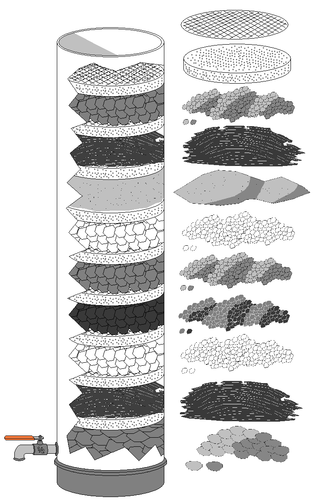
Diagram: Activated carbon filtration
Source: en. wikipedia.org/ wiki/Carbon_ filtering#/ media/File: Water_ Filtration_ Systems.png
Carbon filtering is a method that uses a bed of activated carbon to remove contaminants and impurities, using chemical adsorption ( adhesion of atoms, ions, or molecules from a fluid or dissolved solid to a surface).
Activated carbon traps pollutant molecules inside the pore structure of the carbon substrate.
Each particle/ granule of carbon provides a large surface area/pore structure, allowing contaminants the maximum possible exposure to the active sites within the filter media.
(One pound of activated carbon contains a surface area of approximately 100 acres.)
Because of its molecular makeup, activated carbon can adsorb well, meaning that it can take in or collect many organic molecules on its surface.
Granular activated carbon filters are inexpensive and maintenance involves replacing six to twelve cartridges a year, depending on the quality of the raw water and the filter media.
Active charcoal carbon filters are most effective at removing chlorine, sediment, volatile organic compounds, taste and odor from water. They are not effective at removing minerals, salts, and dissolved inorganic compounds.
Solar sterilization and solar distilation
If it is important the method is cheap, and time is not a concern, leaving the water in a plastic bottle in sunlight might be a good solution.
Clear bottles should left in the sunlight for the UV radiation and heat to kill the microbes.
The time of exposure to the sunlight depends on the availability – sterilization takes longer on cloudy days.
Solar distillation purifies even muddy, salty and undrinkable water using evaporation and condensation.
The sun shines on the impure water, which gets heated and evaporates then condenses and runs into a container.