The Water Network research ...
Published by Water Network Research, Official research team of The Water Network
The Water Network research team has consolidated an answer to the above question.
Further input from members is welcome and appreciated.
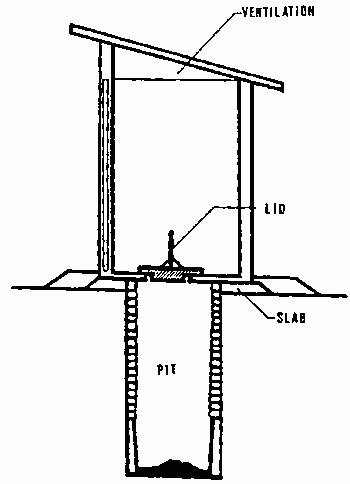 Pit latrine is a toilet type which stores human faeces in a hole in the ground.
They do not use water or use only a couple of liters per flush for pour-flush pit latrines.
Pit latrines consist of 3 parts:
- a hole in the ground
- a slab or floor with a small hole
- a shelter
Pits are at least 3 m deep with an area of 1 m2.
When building a pit latrine a few things need to be taken into consideration:
- It should be far away from the house so that the odor is not a nuisance but close enough and accessible.
- It should be as far away from the surface and groundwater as possible to eliminate the risk of groundwater pollution.
When the pit is almost full (0.5 m of thee top), it should be emptied or a new pit should be constructed.
If faecal sludge management is not carried out properly, water pollution along with public health risks may occur.
During flooding the following things can happen to pit latrines:
- Groundwater pollution due to the groundwater level rise and gets contaminated by human excrement and urine, thereby polluting the water wells
- If the pit design is not adequate, the pit latrine can collapse
- The pit can overflow due to excess water.
The solutions for pit latrines in flood-prone areas include specific pit latrine designs:
Raised pit latrines:
- Earth stabilized raised pit latrine
Earth stabilized raised pit latrines are raised to avoid the water from the flood getting into the pit.
Since the pit is raised, the volume of the pit is larger and therefore the periods between emptying the pit are greater.
However, the space needed for the pit is bigger because there has to be an area to stabilize the soil around the raised part of the pit.
The part of the pit above the ground used for rising it can be both porous and non-porous.
Earth stabilized raised pit latrines are used for all types of flood - river-water flood, rainwater flood, flush flood and tidal flood.
- Step latrine
This latrine is raised to prevent the floodwater from getting into the pit.
The lining used above ground for preventing sullage leaking is non-porous. The extended part of the pit is often water-sealed by plastering both sides.
This type requires less horizontal space but it needs steps for latrine access.
It is a good solution for flood-prone areas with little space.
- Mound latrine
Pit lining is above the ground level to prevent the flood water from entering the pit. The extension part of the pit is surrounded by a mound for protection.
If the lining is made of permeable soil, the lining can be used as a leaching area.
It is also used for flood-prone areas with little space.
Sand enveloped latrines
- Sand enveloped pit latrine
A sad filter around the pit prevents the disease-causing microorganisms from getting into the water supply from the pit.
This type of a pit is especially used it drinking water sources are nearby, minimalizing the risks of groundwater contamination.
A 5 cm thick sand envelope is placed around the pit.
The bottom needs to be impermeable and can be made of plastic or puddle clay.
The horizontal distance between the pit and the drinking water source needs to be at least 10 m.
- Sand enveloped raised pit latrine
This type of latrine can include any of the three previously explained solutions.
The extended part of the lining above ground level is water-sealed or surrounded by earth mound in order to prevent the flood water from intruding the pit.
Aditional resource: