The Water Network research ...
Published by Water Network Research, Official research team of The Water Network
The Water Network research team has consolidated an answer to the above question.
Further input from members is welcome and appreciated.
Coagulation is a water treatment process in which chemicals (coagulants) are added to the water.
It neutralises charges and forms a gelatinous mass to trap particles, forming a large mass that settles or is trapped in the filter.
Dissolved and suspended particles can be found in most of natural waters. These suspended materials mostly come from land erosion, dissolution of minerals and decay of vegetation and domestic and industrial waste discharges.
The water quality is deteriorated with their presence so they have to be removed.
Coagulation and flocculation are relatively simple and cost-effective, provided that chemicals are available and dosage is adapted to the water composition.
In colloidal suspensions the particles would settle very slowly or not at all, since they carry surface charge. Same charges repel each other. Coagulants are added in order to agglomerate the particles.
Coagulants can be classified into:
· inorganic coagulants (e.g., aluminum and ferric salts)
· synthetic organic polymers (e.g., polyacryl amide derivatives and polyethylene imine)
· natural coagulants .
All of them are very efficient at turbidity removal from water.
Coagulation with Aluminium- and Ferric-based coagulants, followed by disinfection by chlorinating is one of the most used methods of water treatment.
Water pretreatment by oxidation might be necessary when using them.
When the coagulants are added to water and stirred for a few minutes they dissolve.
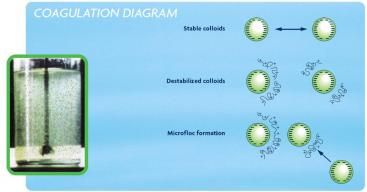
Diagram 1: Coagulation
Source: sswm.info/content/coagulation-flocculation

Coagulation destabilises the charge of the particles.
Coagulants with charges opposite to those of the suspended solids are added to the water to neutralise the charges on dispersed non-settable solids such as clay and organic substances.
Once the charge is neutralised, the small-suspended particles stick together.
The slightly larger particles formed through this process are called microflocs and are invisible to the naked eye.
To achieve good coagulation and formation of the microflocs, a high-energy, rapid-mix to properly disperse the coagulant and promote particle collisions is needed.
Over-mixing does not affect coagulation, but insufficient mixing will leave this step incomplete. Proper contact time in the rapid-mix chamber is typically 1 to 3 minutes.
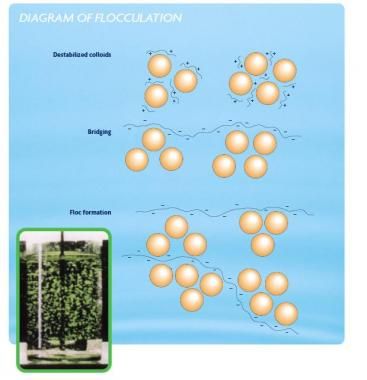
Diagram 2: Flocculation
Source: sswm.info/content/coagulation-flocculation
Flocculation is a process in which the colloids from a suspension form flocs of flakes.
During flocculation, the micro-particles and charged ions are attracted and attached to flocs. The impurities are adsorbed onto the coagulated flocs.
Flocs can further be removed by sedimentation, but only partially and for complete removal filtration may be necessary.
Gentle mixing stage, increases the size of submicroscopic microflocs to larger suspended particles.
With slow mixing, the microflocs are come into contact with each other. Collisions of the microfloc particles cause them to bond to produce larger, visible flocs. The floc size continues to grow through collisions and macroflocs are formed.
Separation is done (sedimentation, floatation or filtration) when the floc has reached its optimum size and strength.
Contact time for flocculation ranges from 15 or 20 minutes to an hour or more.
Since the question is focused on water purification in rural areas, we are going to mention some of the natural coagulants and especially focus on Moringa Oleifera which is easily available in Saudi Arabia where the question author is from.
Some of the natural coagulants are:
· Moringa Oleifera
· Strychnos potatorum, also known as clearing nuts or the nirmali tree, found in India
· Prickly pear cactus, traditionally used in Latin America.
· Fava beans.
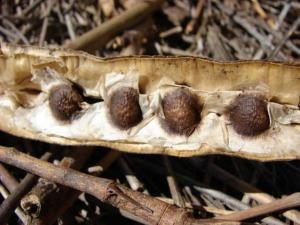 Moringa Oleifera
Natural coagulants are differently available depending on the region, which is both an advantage and a disadvantage.
The Moringa Oleifera tree grows in tropical and subtropical regions.
It needs six months to reach fruition and is used in many areas as a food source. The seedpods, seeds, leaves, roots and flowers are all edible and nutritious.
Moringa Oleifera trees are widely present in Africa, the Middle East and the Indian subcontinent.
It is a fast growing (4.6 meters/year) crop tree that does well in the equator belt climates with non-bogg y soils.
The tree's seed grow in pods. Dried, hulled, and ground seeds have a significant ability to reduce the suspended solids in extremely turbid waters.
Dried beans and seeds can be stored for a long time.
The shelled seeds provide much higher turbidity removal than the non-shelled ones.
Moringa Oleifera is a coagulant and an antimicrobial agent.
When adsorbed onto sand, a protein in dried and ground seeds, has excellent results in removing total suspended solids (TSS) and killing coliform bacteria.
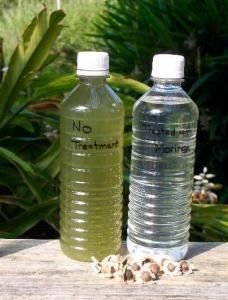
A positively-charged protein called the Moringa Oleifera Cationic Protein (MOCP) is responsible for the excellent water-clarifying ability of the seeds.
When the seeds are crushed and added to water, this protein will kill the microbial organisms and cause them to clump together and settle at the bottom.
Moringa Oleifera seedsalso have the ability to reduce E. Coli.
* A dominant mechanism of MOCP antimicrobial activity is membrane fusion. Cryogenic electron experiments on E. coli cells established that MOCP fuses the inner and outer membranes.
Bacteria and viruses can attach themselves to the suspended particles in water and cause turbidity. Therefore, reducing turbidity levels through coagulation may improve the microbiological quality of water.
The dried seed powder alone is not ideal for water purification because the organic matter from the seed will remain in the water, providing a food source for any bacteria that have not been killed. As a result, water treated with this seed does not remain safe to drink after some time in storage.
Water clarified with Moringa seeds must be used immediately.
| Coagulant | Optimum dose (mg/l) | Turbidity removal (%) | DOC change |
| M. oleifera seeds | 100 | – | 64% reduction |
| M. oleifera seeds | 50 | 90 | >50% increase |
| M. oleifera seeds | 6000 | - | 52% reduction |
| 1-Step purification of M. oleifera | 2 | 97 | 32% increase |
| 2-Step purification of M. oleifera | 2 | 98.5 | 17% increase |
Table 1: Turbidity removal and DOC change depending on the Moringa seeds dose
Source: sciencedirect.com/science/article/pii/S2212371714000171
Documents on TWN about Coagulation and Moringa Olifera: