The Water Network research ...
Published by Water Network Research, Official research team of The Water Network
The Water Network research team has consolidated an answer to the above question.
Further input from members is welcome and appreciated.
Both centralized and decentralized sewage systems have their advantages and disadvantages. Deciding which one to use depends on various factors.
Decentralized system can be:
- Economical – it reduces operation and maintenance costs
- Green and sustainable – using the resources for agriculture and energy, preserving space
- Environmental – reduced pollutants and nutrients, mitigated contamination and health risks
Decentralized sewage is a good solution for rural areas in which the housing is periodically placed or for smart alternative communities.
Ultimately, decentralized wastewater system can be applied in communities of any size and demographic. However, it must be designed properly, maintained and operated in order to provide best results.
Site-specific conditions must be evaluated before deciding on the appropriate type of treatment system.
Some of the parameters that need to be considered before deciding on the best system are the existing infrastructure, climate, water supply, position and depth of groundwater.
It is best to dissect the city into smaller, local zones and analyze the topography and the availability and amount of water supply.
* Since we have insufficient knowledge on the details of these parameters The Water Network team has decided to focus on a couple of the successfully implemented decentralized wastewater treatment solutions.
It is possible to make a completely efficient decentralized system in which
- blackwater (urine and faecal matter) is used as a fertilizer or for energy production
- greywater (water from kitchen sinks and showers) is treated should be treated in low maintenance systems.
Greywater doesn’t contain as many nutrients as blackwater. However, it may contain over 50% of organic matter and high levels of bacteria, even viruses.
Greywater should not, under any circumstances be discharged into rivers without treatment!
- One of the possible solutions is to make a model like or similar to Klosterenga in Oslo, Norway .
At Klosterenga greywater is treated in a nature-based treatment system.
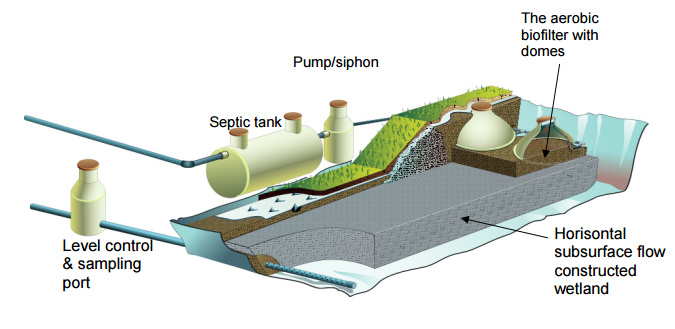
Diagram 1: Klosterenga
Diagram source: umb.no/statisk/ecosan/publications/Klosterenga.pdf
The system was built in 2000 and successfully treats water from around 100 people. The area requirement is 1 m2/person.
The system consists of
- a septic tank
- vertical biofilter (single pass)
- horizontal subsurface flow constructed wetland (porous media filter).
Treated greywater from this system can be used for irrigation or groundwater recharge or discharged to rivers and streams.
The system doesn’t require a lot of space and produces high-quality effluent.
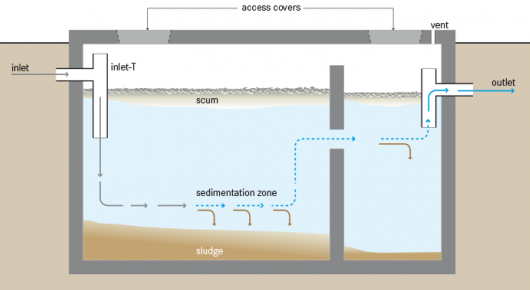
Diagram 2: Septic Tank
Diagram source: sswm.info/category/implementation-tools/wastewater-treatment/hardware/semi-centralised-wastewater-treatments/s
The septic tank is the most used small-scale decentralized unit for grey and blackwater treatment.
Septic tanks are used for wastewater with a high content of settleable solids. Heavy particles accumulate at the bottom and oil and grease float on the top, while the liquid floats through.
The settled solids are anaerobically degraded (but periodical removal is necessary since the accumulation is faster than degradation).
If the removed sludge is dried or composted, it can be used as a fertilizer.
Biofilter captures and biologically degrades pollutants by a bioreactor which contains a living material.
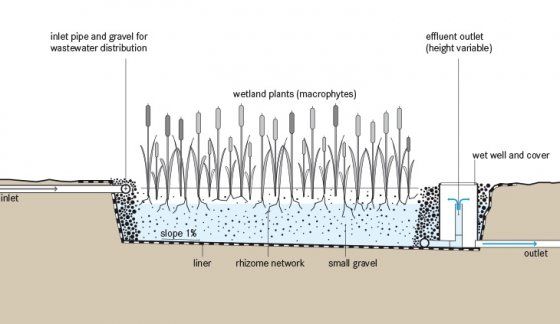
Diagram 3: Horizontal Subsurface Wetland Constructed Flow
Diagram source: sswm.info/category/implementation-tools/wastewater-treatment/hardware/semi-centralised-wastewater-treatments/h
Horizontal Subsurface Wetland Constructed Flow are relatively cheap, easy to maintain and require no electricity or chemicals.
They are used as a secondary or tertiary wastewater treatment.
The filter media removes the remaining solids. Most organics are degraded by anaerobic bacteria but wetland vegetation a small amount of oxygen comes from the roots therefore enabling aerobic bacteria to degrade the organics. Plant roots play an important role in maintaining the permeability of the filter.
- Another example of a decentralized greywater treatment system is implemented in Xi'an, China .
It uses a dual-pipe system for separate collection of grey and blackwater.
The system collects water at a flow rate of 100 m3/day from 6 buildings.
Blackwater is treated in a septic tank and greywater is treated by a hybrid physicochemical process using a fluidized pellet bed separator as the first stage and by ozone enhanced flotation as the second stage.
All treated water is used for artificial pond replenishment, gardening, road-washing and other non-potable purposes.
Documents on Decentralized water systems on TWN:
- Suitability of Grey Water Recycling as decentralized alternative water supply option
- Wastewater Management Strategy: centralized v. decentralized technologies for small communities
- Process of Developing Urban Wastewater Policy for Afghanistan xCatering to Decentralized Wastewater Management...
- Decentralized Sanitation and Wastewater Treatment
- Decentralised vs. Centralised Wastewater Systems