The Water Network research ...
Published by Water Network Research, Official research team of The Water Network
The Water Network research team has consolidated an answer to the above question.
Further input from members is welcome and appreciated.
Total Dissolved Solids (TDS) are all the minerals, salts, metals and ions (cations and anions) in the water.
Pure water is a universal solvent – it easily dissolves the inorganic salts (Ca, Mg, Na, bicarbonates, chlorides and sulphates) and some of the organic matter, hence the dissolved solids in water.
TDS in water has different origins - natural sources (leaves, silt, plankton), sewage, urban run-off, industrial wastewater, and chemicals used in the water treatment process.
They also come from rocks and air that contain certain minerals.
Another source of TDS are the metals water picks up while going through pipes while being distributed.
TDS is directly related to the purity of water and the quality of water purification systems and affects everything that consumes, lives in, or uses water.
TDS concentration is a secondary drinking water standard.
Therefore, elevated levels are not a health hazard, but the water has greater hardness, may create deposits and be corrosive, water may be coloured and have a salty and brackish taste.
By the EPA standards TDS should not exceed 500 mg/l.
By the WHO standards TDS in water classify as following:
Level of TDS [mg/l] | Rating |
Less than 300 | Excellent |
300 - 600 | Good |
600 - 900 | Fair |
900 - 1,200 | Poor |
Above 1,200 | Unacceptable |
For comparison, it is useful to state that most aquatic ecosystems with different fish fauna tolerate TDS levels of 1000 mg/l.
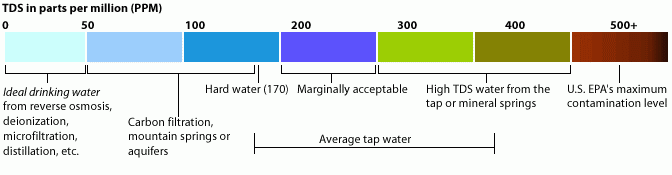
Diagram 1: TDS in ppm
Source: tdsmeter.com/what-is#what
Treating TDS depends on which solids are dissolved in the water:
- If TSD are calcium, magnesium or iron a water softener should be used.
- If concentrations of sodium, chloride, or potassium are elevated reverse osmosis should be used as a water treatment.
- For high to iron, manganese, arsenic concentrations or total hardness in general, other methods should be used.