Permissible range of total ...
Published by Water Network Research, Official research team of The Water Network
Permissible range of total dissolve solid (TDS) in drinking water
The water network's editors and research team has consolidated an answer to the above question. More inputs from members are welcomed and appreciated.
Total dissolved solids (TDS) : comprise inorganic salts and small amounts of organic matter that are dissolved in water. The principal constituents are usually the cations calcium, magnesium, sodium and potassium and the anions carbonate, bicarbonate, chloride, sulphate and, particularly in groundwater, nitrate .TDS is expressed in units of mg per unit volume of water (mg/L) or also referred to as parts per million (ppm)
Permissible range of TDS in drinking water: Different government has different regulations for the TDS level. The U.S. EPA sets the maximum contaminant level for TDS 500 ppm where as WHO has different prescribe limits.
An aesthetic objective of ≤500 mg/L has been established for total dissolved solids (TDS) in drinking water by WHO. At higher levels, excessive hardness, unpalatability, mineral deposition and corrosion may occur. At low levels, however, TDS contributes to the palatability of water. Most people think of TDS as being an aesthetic factor. In a study by the World Health Organization, a panel of tasters came to the following conclusions about the preferable level of TDS in water:
Taste of Water with Different TDS Concentrations | |
Level of TDS (milligrams per litre) | Rating |
Less than 300 | Excellent |
300 - 600 | Good |
600 - 900 | Fair |
900 - 1,200 | Poor |
Above 1,200 | Unacceptable |
Sources of TDS : Some dissolved solids come from organic sources such as leaves, silt, plankton, and industrial waste and sewage. Other sources come from runoff from urban areas, road salts used on street during the winter, and fertilisers and pesticides used on lawns and farms.Dissolved solids also come from inorganic materials such as rocks and air that may contain calcium bicarbonate, nitrogen, iron phosphorous, sulfur, and other minerals. Many of these materials form salts, which are compounds that contain both a metal and a nonmetal. Salts usually dissolve in water forming ions. Ions are particles that have a positive or negative charge. Water may also pick up metals such as lead or copper as they travel through pipes used to distribute water to consumers.
Methods for removing or reducing the TDS from water
There are 3 common methods for removing or reducing the TDS from the water
1. Distillation : distillation is one of the most effective forms of treatment and also one of the easiest to understand- untreated water is converted into water vapor, which is then condensed back into liquid form. Most of the contaminants are left behind in the boiling chamber, with the condensed water being virtually contaminant-free.

Digram : distillation process
Diagram source : drinkitclear.com
2. Reverse Osmosis (RO) : remove TDS by forcing the water, under pressure, through a synthetic membrane. The membrane contains microscopic pores which will allow only molecules smaller than 0.0001 micron to pass through. Since the molecules of dissolved metals and salts are large compared to the water molecules, the water will squeeze through the membrane leaving the metals and salts behind. A professional Reverse Osmosis system is capable of removing 90-99% of the dissolved mineral salts from water.
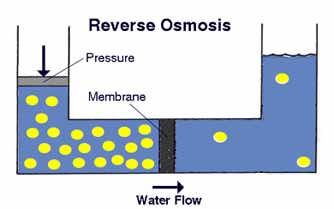
Digram: principle of RO
Diagram source: tdsmeter.com/what-is?id=0013
3.Deionization (DI) : Water is passed between a positive electrode and a negative electrode. Ion selective membranes allow the positive ions to separate from the water toward the negative electrode and the negative ions toward the positive electrode. High purity de-ionized water results. The water is usually passed through a reverse osmosis unit first to remove nonionic organic contaminants.

Digram: Simplified potable mixed bed Deionizer
Diagram source : Aquatechnology.net
Additional resources
Detailed TDS and safe water information
WHO guidelines for drinking water TDS level
The US EPA's list of National Secondary Drinking Water Regulation
Distillation method of TDS removal
Reverse Osmosis method for TDS removal
Deionisation method for TDS removal
Carbon filter method for TDS removal
Read More Related Content On Total Dissolve Solid (TDS) here
Related question: How to reduce TDS level in golf course irrigation water?