The Water Network research ...
Published by Water Network Research, Official research team of The Water Network
The Water Network research team has consolidated an answer to the above question.
Further input from members is welcome and appreciated.
Chemical Oxygen Demand (COD) is a measurement of all organic and inorganic compounds in water.
It is related to Biological Oxygen Demand (BOD), which is the amount of oxygen required for the bacteria to degrade the organic compounds in water.
COD is practical for testing water quality in surface waters and wastewater since it determines organic pollutants.
COD is the mass of oxygen consumed per solution [mg/l] and almost all organic compounds can be oxidized to carbon dioxide (CO2) in acidic conditions with a strong oxidizing agent.
Potassium permanganate, ceric sulphate, potassium iodate, and potassium dichromate are the oxidizing agents used to determine COD.
Potassium dichromate (K2Cr2O7) is the most effective and it is not too expensive, is easy to purify and can completely oxidize most of organic compounds.
If the BOD/COD ratio of untreated wastewater is 0.5 or greater, the waste is easily treatable by biological methods. If the ratio is below about 0.3, either the waste may contain toxic components or acclimated microoorganisms may be required in its stabilization.
To reduce COD and BOD there are a couple of methods to be used:
- Chemical methods
- Physical methods
- Physico-chemical methods
Secondary treatment of the industrial wastewater treatment plant i.e. biological treatment such as activated sludge process, sequential batch reactor, upflow anaerobic sludge blanket reactor, etc. is used to remove BOD .
For, COD removal, primary treatment of the industrial wastewater treatment plant i.e. settling, advanced oxidation, physio-chemical, etc. are used.
- Physical methods:
Screening is the primary treatment in a wastewater treatment plant. It is used to remove garbage which would pose problems downstream causing clogging and damage. It separates and gets rid of rags, paper, plastic and metals.
The space between the screening bars differs and determines the efficiency of screening:
- Fine screening - under 10 mm
- Medium screening - 10 to 40 mm
- Coarse screening - over 40 mm
The screening bar needs to be cleaned manually or automatically and this reduces the frequency of screenings.
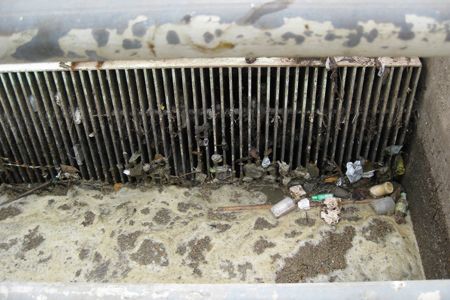
Diagram 1: Screening
Source: wateronline.com/doc/wwema-window-slots-vs-holes-in-preliminary-treatment-screening-0001
Sand and/or Multi Media Filtration filters the suspended and dissolved solids. Secondary filtration is often needed. though, as smaller solids may pass through.
Membrane Filtration removes suspended and dissolved solids solids thanks to barrier membranes (microfiltration and ultrafiltration) or semipermeable membranes (nano and reverse osmosis)
Sedimentation relies on gravity to naturally remove suspended solids in still water.
If the water is undisturbed, solid particles will settle at the bottom of the sedimentation tank, depending on the size of the particles. They will further be mechanically removed by clarifiers.
The particles will settle if:
- the ascending water velocity is lower than the limit sedimentation velocity, in a vertical ascending flow
- ratio length/height of the tank is greater than water velocity/limit sedimentation velocity, in a longitudinal flow.
Settleable solids are the visible volume accumulated at the bottom of an Imhoff cone after water has settled for an hour.
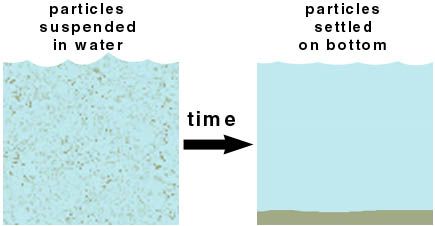
Diagram 2: Sedimentation
Source: sswm.info/content/sedimentation
- Physico-chemical methods:
Coagulation is a water treatment process in which chemicals (coagulants) are added to the water.
It neutralises charges and forms a gelatinous mass to trap particles, forming a large mass that settles or is trapped in the filter.
Coagulation and flocculation are relatively simple and cost-effective, provided that chemicals are available and dosage is adapted to the water composition.
In colloidal suspensions the particles would settle very slowly or not at all, since they carry surface charge. Same charges repel each other. Coagulants are added in order to agglomerate the particles.
Coagulants can be classified into:
· inorganic coagulants (e.g., aluminum and ferric salts)
· synthetic organic polymers (e.g., polyacryl amide derivatives and polyethylene imine)
· natural coagulants .
All of them are very efficient at turbidity removal from water.
Coagulation with Aluminium- and Ferric-based coagulants, followed by disinfection by chlorinating is one of the most used methods of water treatment.
Water pretreatment by oxidation might be necessary when using them.
When the coagulants are added to water and stirred for a few minutes they dissolve.
Coagulation destabilises the charge of the particles.
Coagulants with charges opposite to those of the suspended solids are added to the water to neutralise the charges on dispersed non-settable solids such as clay and organic substances.
Once the charge is neutralised, the small-suspended particles stick together.
The slightly larger particles formed through this process are called microflocs and are invisible to the naked eye.
To achieve good coagulation and formation of the microflocs, a high-energy, rapid-mix to properly disperse the coagulant and promote particle collisions is needed.
Over-mixing does not affect coagulation, but insufficient mixing will leave this step incomplete. Proper contact time in the rapid-mix chamber is typically 1 to 3 minutes.
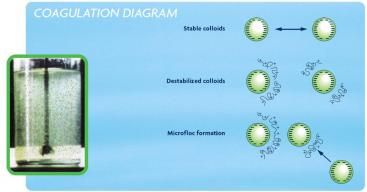
Diagram 3: Coagulation
Source: sswm.info/content/coagulation-flocculation
Flocculation is a process in which the colloids from a suspension form flocs of flakes.
During flocculation, the micro-particles and charged ions are attracted and attached to flocs. The impurities are adsorbed onto the coagulated flocs.
Flocs can further be removed by sedimentation, but only partially and for complete removal filtration may be necessary.
Gentle mixing stage, increases the size of submicroscopic microflocs to larger suspended particles.
With slow mixing, the microflocs are come into contact with each other. Collisions of the microfloc particles cause them to bond to produce larger, visible flocs. The floc size continues to grow through collisions and macroflocs are formed.
Separation is done (sedimentation, floatation or filtration) when the floc has reached its optimum size and strength.
Contact time for flocculation ranges from 15 or 20 minutes to an hour or more.
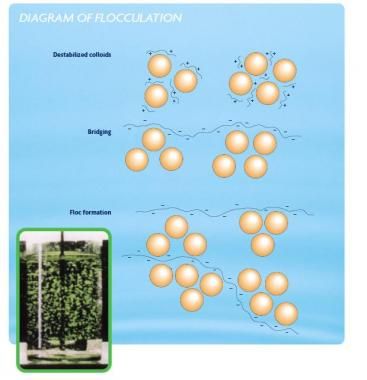
Diagram 3: Flocculation
Source: sswm.info/content/coagulation-flocculation
Documents on TWN about COD:
- The determination of chemical oxygen demand in waters and effluents
- The Chemistry of Chemical Oxygen Demand
- COD Removal of Different Industrial Wastewater by Fenton Oxidation Process
- An Operator’ s Guide to Water Treatment Coagulants
- Coagulation and Flocculation
- Coagulation, flocculation and clarification
- Coagulation, Flocculation and Clarification of Drinking Water