The Water Network research ...
Published by Water Network Research, Official research team of The Water Network
The Water Network research team has consolidated an answer to the above question.
Further input from members is welcome and appreciated.
In sewage treatment air is passed through a mixture of sewage and old sludge. The air is necessary for microorganisms to decompose organic components.
As new sewage enters the tank, treated sludge exits. For this to work, the sludge should be settled so that supernatant can be further treated.
If sludge does not separate and settle in sedimentation tanks and remains “floating”, sludge bulking has occurred.
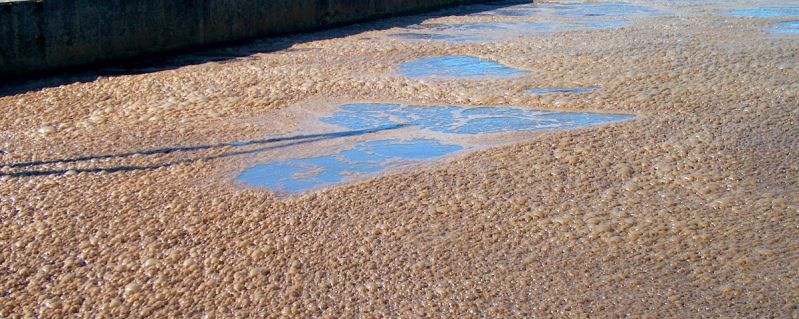
Filamentous bacteria are the most common cause of sludge bulking.
Filamentous microorganisms grow in long strands with bigger volume and surface than flocs so they settle very slowly.
Excessive filamentous development is often caused not only by environmental conditions but also by the influent itself which may contain food for bacteria.
Microscopic examination determines which type of filamentous bacteria is present and determines the treatment that should be applied.
The following table shows the causes of filament growth :
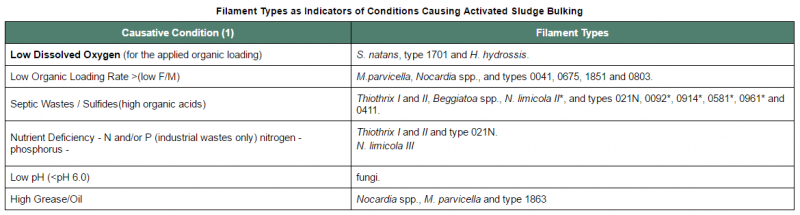
Table 1: Filament Types as Indicators of Conditions Causing Activated Sludge Bulking
Table 1 source: dec.ny.gov/chemical/34373.html
Low Dissolved Oxygen Concentration
The necessary dissolved oxygen (DO) concentration to prevent bulking does not remain constant all the time. It is a function of the F/M rate. The F/M rate (food to microorganism) is a control number for determining the proper number of microorganisms for the system.
As the F/M rate increases, more oxygen is used and needed to maintain the aerobic conditions inside the flocs. The dissolved oxygen concentration should, therefore, be increased to keep the oxygen diffusion into the flocs.
Recommended DO concentration for most wastewater plants (F/M up to 0.5) is 2.0 mg/l. (This concentration should be measured at the head-end of a plug-flow system, not the back-end.)
To control bulking due to low DO, the aerations basin DO concentration and mixed liquor suspended solids (MLSS) concentration should be raised.
Increasing MLSS will decrease the F/M.
However, low F/M may cause filamentous bulking.
Filamentous bulking is treated my decreasing the MLSS which should be done with caution because it may decrease nitrification and cause more waste sludge to be produced.
Additionally, low F/M can be adjusted with some of the methods which do not affect the MLSS: compartmentalization of aeration basins; fed-batch operation; intermittent feeding of wastes; and use of a selector.
Septicity
Wastewater becomes septic when organic matter decomposes and forms a foul smell due to the absence of free oxygen.
If wastewater is severely septic, it will produce hydrogen sulfide, turn black and give off a foul odor.
Septicity in a sewage system occurs when microorganisms use up all the dissolved oxygen and nitrates in the sewage.
Without oxygen, anaerobic conditions develop and bacteria reduces the organic compounds to sulphur and sulfide. Then sulfate- reducing bacteria utilize sulfates to form sulfides which increase the filament growth.
*Read more about conditions in which septicity occurs and about how to reduce septicity here.
Waste septicity is treated by preaeration (which releases odors), by chemical oxidation (chlorine, hydrogen peroxide or potassium permanganate), by chemical precipitation (ferric chloride), or use of sodium nitrate in the collection system as an "oxygen source".
Low Nutrients
Lack of nutrients such as nitrogen and phosphorous can limit activated sludge growth.
Nutrient deficiency can be prevented by keeping the concentrations in the effluent water at 1.0 mg/l of total inorganic nitrogen and 0.5-1.0 mg/l of ortho-phosphorus.
Otherwise filamentous bulking and foaming may occur.
Low pH
The pH in the aeration basin should be kept at 6.5 – 8.5.
Lower pH can induce the fungi to grow and cause fungal bulking.
The pH should be adjusted using caustic, lime or magnesium hydroxide.
Physical and chemical methods to control the filaments:
Polymer Addition
Synthetic, high molecular weight, cationic polymers (with or without the anionic polymer) can be added to control the filaments.
They are added to MLSS which leaves the aeration basin or to the secondary clarifier center well.
Polymers can be expensive, even $450 per million gallons, but they do not increase the sludge production too much.
Inert Material Addition
If lime of ferric chloride are added they coagulate and precipitate the activated sludge and make it settle easier.
However, their usage may greatly increase the sludge production.
*Adding flocculants if the problem is caused by filamentous bacteria only treats the ‘symptom’ and is not efficient in the long run.
Chlorination
Chlorine and hydrogen peroxide can control the filaments.
Chlorine is fairly cheap and easily available so it is most commonly used.
The chlorine dose should be lethal to the organisms only on the surface of the floc so that chlorination damages the filaments on the surface of the floc while leaving the floc inside undisturbed.
If the problem is not filamentous, chlorination can actually bring more damage.
Chlorine is applied from a chlorinator using chlorine gas feed or as a liquid hypochlorite.
It is crucial to determine the right spot for chlorination: where sludge is concentrated, raw wastes are at a minimum, and at a point of good mixing.
Chlorine should NOT be added to the aeration basin since it will cause the flocs to disperse and may damage the system.
Chlorine dosage should be started at low concentrations and gradually increased until it becomes effective.
The chlorination frequency is the function of the relative growth rates and the efficacy of killing the filamentous and floc-forming organisms.
Chlorination is not too efficient in controlling sludge bulking. It only gets rid of filament extensions which will regrow after the chlorination is over.
Related documents: