Sir.....easy to fix...just add a very small amount of our product - Solutek. Been around for 20 years .... we have huge amounts of data ... fully organic product.
I don't know what you mean by "sludge bulking", but low levels of dissolved oxygen are fixed by introducing oxygen, generally by aeration. Can you please explain what you mean by sludge bulking?
Simple....add small quantities of our 100% fully organic solution - SOLUTEK.
this has been working in waste water treatment plants for large twosn for 15 years and in small systems for 20 years...after a short time of treatment...no more sludge and after just 5 days, no more odor.
Estimado mesi, es Necesario conocer La Causa, bajo esta premisa un bajo nivel de oxigeno no obedecen siempre a la misma sino comprenden el efecto.
con esto te quiero decir que aunque tu sistema trata unas aguas que pueden parecer inofensivas, estas pueden llevar sobrecargas, toxicos o causan una especie de problema que a primera vista no se ve.
mi recomendacion:
revisar relacion F/M
revisar concentraciones de grasas, sulfuros o cualquier otra sustancia que ya identificada pueda causar tu problema.
Alguna vez estuvo tu planta estable?, tienes datos de esta misma y podrias retroalimentarnos con el seguimiento de la misma.
el oxigeno por si solo no te muestra el problema es solo un sintoma que mas has visto que ha cambiado?
quieres mas consejos,
puedes enviarme el seguimiento a tu sistema a o.lparada@gmail.com,
The Water Network research team has consolidated an answer to the above question. Further input from members is welcome and appreciated.
In sewage treatment air is passed through a mixture of sewage and old sludge. The air is necessary for microorganisms to decompose organic components.
As new sewage enters the tank, treated sludge exits. For this to work, the sludge should be settled so that supernatant can be further treated.
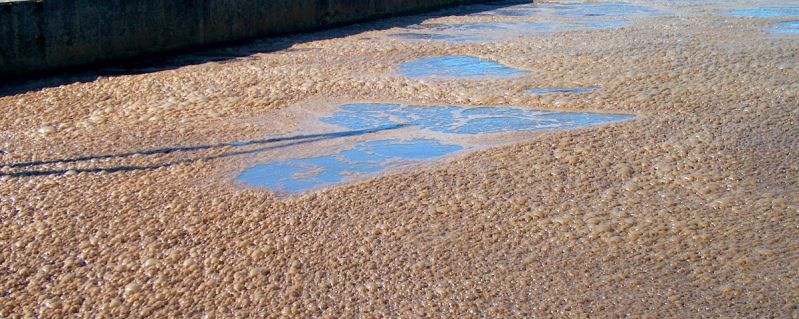
If sludge does not separate and settle in sedimentation tanks and remains “floating”, sludge bulking has occurred.
Filamentous bacteria are the most common cause of sludge bulking.
Filamentous microorganisms grow in long strands with bigger volume and surface than flocs so they settle very slowly.
Excessive filamentous development is often caused not only by environmental conditions but also by the influent itself which may contain food for bacteria.
Microscopic examination determines which type of filamentous bacteria is present and determines the treatment that should be applied.
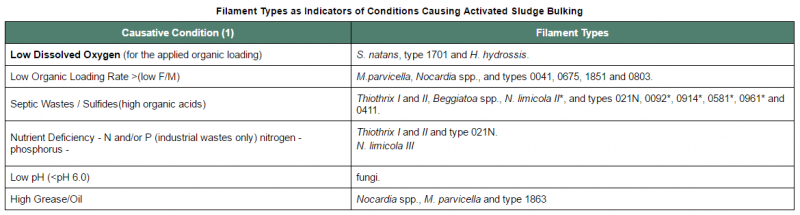
The following table shows the causes of filament growth :
Table 1: Filament Types as Indicators of Conditions Causing Activated Sludge Bulking Table 1 source: dec.ny.gov/chemical/34373.html
Low Dissolved Oxygen Concentration
The necessary dissolved oxygen (DO) concentration to prevent bulking does not remain constant all the time. It is a function of the F/M rate. The F/M rate (food to microorganism) is a control number for determining the proper number of microorganisms for the system.
As the F/M rate increases, more oxygen is used and needed to maintain the aerobic conditions inside the flocs. The dissolved oxygen concentration should, therefore, be increased to keep the oxygen diffusion into the flocs.
Recommended DO concentration for most wastewater plants (F/M up to 0.5) is 2.0 mg/l. (This concentration should be measured at the head-end of a plug-flow system, not the back-end.)
To control bulking due to low DO, the aerations basin DO concentration and mixed liquor suspended solids (MLSS) concentration should be raised.
Increasing MLSS will decrease the F/M.
However, low F/M may cause filamentous bulking.
Filamentous bulking is treated my decreasing the MLSS which should be done with caution because it may decrease nitrification and cause more waste sludge to be produced.
Additionally, low F/M can be adjusted with some of the methods which do not affect the MLSS: compartmentalization of aeration basins; fed-batch operation; intermittent feeding of wastes; and use of a selector.
Septicity
Wastewater becomes septic when organic matter decomposes and forms a foul smell due to the absence of free oxygen.
If wastewater is severely septic, it will produce hydrogen sulfide, turn black and give off a foul odor.
Septicity in a sewage system occurs when microorganisms use up all the dissolved oxygen and nitrates in the sewage.
Without oxygen, anaerobic conditions develop and bacteria reduces the organic compounds to sulphur and sulfide. Then sulfate- reducing bacteria utilize sulfates to form sulfides which increase the filament growth.
*Read more about conditions in which septicity occurs and about how to reduce septicity here.
Waste septicity is treated by preaeration (which releases odors), by chemical oxidation (chlorine, hydrogen peroxide or potassium permanganate), by chemical precipitation (ferric chloride), or use of sodium nitrate in the collection system as an "oxygen source".
Low Nutrients
Lack of nutrients such as nitrogen and phosphorous can limit activated sludge growth.
Nutrient deficiency can be prevented by keeping the concentrations in the effluent water at 1.0 mg/l of total inorganic nitrogen and 0.5-1.0 mg/l of ortho-phosphorus.
Otherwise filamentous bulking and foaming may occur.
Low pH
The pH in the aeration basin should be kept at 6.5 – 8.5.
Lower pH can induce the fungi to grow and cause fungal bulking.
The pH should be adjusted using caustic, lime or magnesium hydroxide.
Physical and chemical methods to control the filaments:
Polymer Addition
Synthetic, high molecular weight, cationic polymers (with or without the anionic polymer) can be added to control the filaments.
They are added to MLSS which leaves the aeration basin or to the secondary clarifier center well.
Polymers can be expensive, even $450 per million gallons, but they do not increase the sludge production too much.
Inert Material Addition
If lime of ferric chloride are added they coagulate and precipitate the activated sludge and make it settle easier.
However, their usage may greatly increase the sludge production.
*Adding flocculants if the problem is caused by filamentous bacteria only treats the ‘symptom’ and is not efficient in the long run.
Chlorination
Chlorine and hydrogen peroxide can control the filaments.
Chlorine is fairly cheap and easily available so it is most commonly used.
The chlorine dose should be lethal to the organisms only on the surface of the floc so that chlorination damages the filaments on the surface of the floc while leaving the floc inside undisturbed.
If the problem is not filamentous, chlorination can actually bring more damage.
Chlorine is applied from a chlorinator using chlorine gas feed or as a liquid hypochlorite.
It is crucial to determine the right spot for chlorination: where sludge is concentrated, raw wastes are at a minimum, and at a point of good mixing.
Chlorine should NOT be added to the aeration basin since it will cause the flocs to disperse and may damage the system.
Chlorine dosage should be started at low concentrations and gradually increased until it becomes effective.
The chlorination frequency is the function of the relative growth rates and the efficacy of killing the filamentous and floc-forming organisms.
Chlorination is not too efficient in controlling sludge bulking. It only gets rid of filament extensions which will regrow after the chlorination is over.
crowdsource challenges and solutions via the Marketplace
You may find solutions to your challenge or even post this challenge and get solutions via an exclusive infrastructure community, the Marketplace of the Innovation Interchange https://www.innovationinterchange.com/products/marketplace
When facing intractable challenges, owners and operators of infrastructure assets can find solutions from across the globe via the technology Marketplace. Register free online and connect with other organizations as you crowd source challenges and solutions.
Published
by michelle arroyo, Innovation Interchange - Communications and Support
Dear every one thanks for putting efforts in answering my question. As I said the system is having low oxygen, we have increased the oxygen level and can see some difference. Thanks once again for your wonderful answers and comment. Keep smiling.
There are several reasons for sludge bulking and many of them have been reported by colleagues. One question arises: are you sure that it is bulking sludge? Have you loked at the microscope. If yes, fine and you can use ideas already done.
Bulking can be said to have occurred in activated sludge plants when the sludge does not settle easily and has an excessive volume. high F:M ratio requires a high DO concentration for effective treatment of the BOD load. However at low DO concentrations and at high F:M ratios excessive filamentous growth may occur leading to bulking. Bulking due to low DO can occur in a short space of time. A correction mechanism could be to increase the DO in the aeration tank.
Another issue in the activated sludge process is sludge age. If it is too old, filamentous bacteria develop, and prevent sludge from settling properly. You should be able to find plenty of reference material about testing sludge age and interpreting the results.
Some people add hydrogen peroxide to control the filamentous bacteria, but this is strictly a stop-gap measure.
Dissolved oxygen could be a factor. If a septic condition occurs, the bacteria go to the nitrate and nitrite compounds for oxygen, releasing gas bubbles that can buoy the sludge.
Dear Mr. Mesi, You need to maintain a slope in the sludge drain, as sludge sedimentation slowly clogs the drainage if no acceptable slope is available to enhance the flow and reduce clogging of drains. Said
There could be multiple reasons for sludge bulking. The fact that your problem is starting at the start of colder period, would suggest the presence of filamentous bacteria such as microthrix parvicella or nocardia. It is recommended to do a microbiological identification. Once identified, there are specific treatments to reliably solve and prevent reoccurence of bulking.
there are some bacteria called free-flow bacteria...by seeding these bacteria in your sludge ....can improve the microbial activity of your sludge....and can solve your problem...
How to fix a problem of Sludge bulking in waste water treatment plant
Sludge bulking is cumulation of suspended solids, not connected to low DO. WHile it is true that sludge(both organic and inorganic) consumed DO there's no sense to connect the low DO and the sludge bulking. In principle, you will have your sludge through time and the thing to do is to remove it. It will be easy to remove such by identifying if your sludge is cationic or anionic then you can add the sufficient amount of specific coagulant then filter it out.
Your query is much too general to respond to in any meaningful way. There are many options and technologies available but without some idea of the characterization of the industrial waste stream it is not possible to suggest anything. The basics to even open a discussion would be: 1. Characterization of the wastewater ( hydraulic and chemical/biological/physical characterization? 2. What is the receiver and what are the effluent discharge criteria? 3. Where is the project? 4. Is this a new facility of a modification to an existing one?