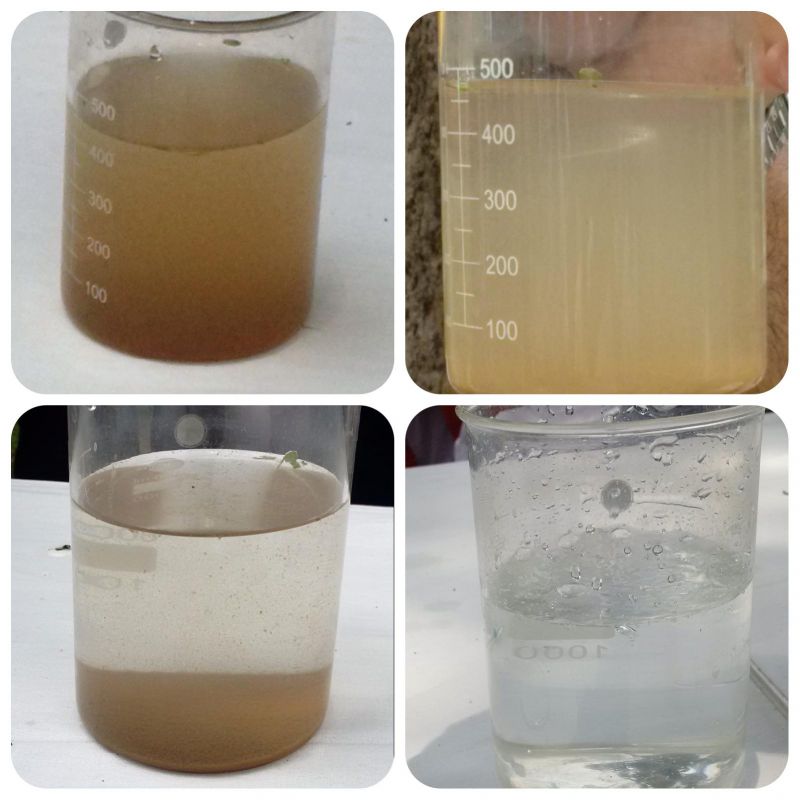
In the Foster Home that we support in Ghana, the water from 60 m deep bore well can no longer be used for drinking due to a mud contamination. The water quality (specifications) is still good, but the mud colors the water brown and negatively impacts the taste.
The well water is pumped via a PVCpipe to 4 reservoirs (plastic containers), filtered, and then distributed to approx 100 users.
The question is what filtration/purification system can we use to best alleviate these negative effects and where should the filters be installed? Can we add something in bore well itself to get better water?
Please note that we are situated in a rural area, with limited access technical support and spare parts.
Aquathin manufactures a broad spectrum of unique and proprietary water purification, softening and filtration systems servicing the residential, commercial and laboratory markets.
Established in 1980 Aquathin has earned 7 Patents and now produces over 70 proprietary and trademarked devices for markets around the world. Aquathin is an E.P.A. Registered manufacturer, ISO9001:2000, ISO9001:2008 Certified and recipient of both the prestigious President's Excellence & E Star Award in Export from the U.S. Commerce Department and the Nation's Blue Chip Enterprise Award from the U.S. Chamber of Commerce. Aquathin purification, softening and filtration products are Made In USA and WQA Quality and Efficiency Gold Seal Certified. We cordially invite you to visit www.aquathin.com .
For Sales, Service and Technical Support in Ghana please contact our friends and longstanding excellent Distributor at: AQUATHIN GHANA Simon Seddoh Bokor, Executive Manager
Ladosi Ventures // Aquathin Ghana
P.O. Box DT 2752, Adenta / Greater Accra Region / Ghana, AFRICA
Try pumping the water to an elevated storage tank. place the outlet a foot or so above the bottom of the tank to allow mud to settle to the bottom leaving pure water on top where the outlet is. Bottom of tank will need to be drained of mud periodically. My 2 cents.
The colours associated with clays and muds are finely divided colloids and fines and sometimes soluble humic and fulvic acids. These contaminants can pass through filters or rapidly block filters. The most appropriate treatment that I have is used is Coagulation > Flocculation and Clarification and then use the filter as a final barrier. For remote sites, electro-coagulation, -flocculation and lamella clarifier work well. The electrical energy for electro-coagulation being generated by solar pv or other renewable energy source. See attached file showing picture of Solar based drinking water package treatment plant incorporating all these features.
Use Charcol filter done wth Burned wood & crush an too differents diameters of sands, all that with gravity, IF POSSIBLE PUT IN INOX PIPE UVB, LED Tube of 100 Cm 150-340 Nanometers ondes with water circulation inside for complete circulation but at beginning U(ve tomake a pond for mud first deposit then to join in anther one Yogurt for probiotic treatment an too microAlgae for Nitrates treatment. This water could be completely pure, not expansive if U're a little cleaver (200 Euros total) an solar electricity include for the UVB leds. With this purifiezd water U can farm too fishes and shrimps for people feeding.
If U need more infos, contact me ray.dalaiseMohummadrashid@gmail Siddiqui
Low Cost 'TERAFIL' Water Filter developed by CSIR-IMMT, Bhubaneswar, India
Application : TERAFIL is a low cost burnt red clay porous media (disc/candle), used for filtration & treatment of turbid raw water into clean drinking water for domestic/ community applications. Suspended particles, sediment, iron & many heavy metals, micro-organism, colour & bad odour etc are separated from raw water effectively during filtration, without clogging the core of the TERAFIL. It can be fixed with any container for purification of water. Quality of product water is within BIS limits, especially for turbidity, iron & micro-organisms. Cost of purification is within Rs.2/- per ton of product water, considering total cost of plant. It operates without electricity, spent water and sludge management. Average life of TERAFIL media is five years. 1 to 50,000 lit/day capacity filter/plants is available for domestic, online & community applications.
Raw Materials: Pottery clay, sand & wood saw dust for preparation of TERAFIL media (disc/candle).
Process Features: TERAFIL is prepared out of a mixture of sand, red clay & wood saw dust. Terafil media comprises of thin clay walls (clay membranes) and each clay wall separated by large size pores. The thin clay walls contain ultra-fine capillary openings (sub-micron in size) which bridge the pores. Raw water flows from one pore to anther through capillary openings during filtration in Terafil media, leaving behind sediments, suspended particles etc on top surface of Terafil. Terafil helps for effective filtration & treatment of raw water into clean drinking water. Terafil is fitted at the bottom of any container for filtration and treatment of raw water.
Link http://www.immt.res.in/TERAFILWaterFilter.aspx
First you have to use the sedimentation Technic using settling tanks by adding coagulants and chemical agents to speed the process.
Second take the from the surface through weer channels to a sand filter for filtration and collect in a filtered water tank, than adding a small dose of chlorine for disinfection.
Third, take a sample for laboratory testing to make sure the quality is within standards.
Dear all please find attached my information, the Nadi filter water unit is useful to filter muddy water and make is 100% pure and free from Biological contamination, for further more check my profile and contact me if needs more info at ahdpak@gmail.com
Please drill another Borehole and blend the water, again the water must pump at night to the reservoir to allow settle ability to take place. You can installed extra filters according to size, as you speak the flow rate never mentioned here. Again you can use package plant to treat that colour or muddy. You also create a slow sand filtration, where water can dose with ferric chloride before flow into sedimentation tank.
You dont need any kind of Infrastructure if I believe one can just use a pinch of alum and leave it to stand.can be done at Individual homes and in small vessels and the same piece of alum be used in different vessels.Just let the piece be in hand for say 30 secs, whirl it around and leave it undisturbed.Hope this helps.
This is Practised regularly in rural and urban India since generations.
Normally the borewell water mud colour is due to oxidized iron content in the ground water. Please confirm whether its mud or iron. If its mud you can use a settling tank with alum or polyelectrolyte as coagulant. If its iron then aeration and sedimentation will give you good result. In both the cases you can use a pressure sand filter for better quality.
Use Solutek in the overhead tanks...it is a flocculent and will also get rid of any carbonaceous materials whatsoever. There are a number of filter solutions that you could then use if you wish. Perhaps you may need to add some type of safe anti-bacterial solution.
Use Solutek in the overhead tanks...it is a flocculent and will also get rid of any carbonaceous materials whatsoever. There are a number of filter solutions that you could then use if you wish. Perhaps you may need to add some type of safe anti-bacterial solution.
The appearance of mud seems to be a very unlikely development at a working abstraction well. Usually mud can be present at the beginning of the operation but not after what is termed the well development. Before serious money is spent on anything else than interim treatment options the cause should be identified as this might just be a transient problem, due for instance to well pipe corrosion and wall collapse. In my experience the presence of iron might lead to well clogging and a slight colouring and or turbidity of the water but that is not mud.
If you have data 'll be happy to assist. Below some questions:
Does the mud settle?
For how long has the problem been going on? How much water has been pumped since the onset? Is the problem worsening, constant or getting better?
Can a well depth measurement be performed, even if only up to the depth at which the pump is located? (Turn off the pump!)
Can you provide analytical data of the water before and after the change?
Do you have pictures of the muddy water?
Can you provide information about the geological materials the well is hosted in? One of the good things with ground water is that often it is geologically prefiltered and most of the time there is no need for additional treatment measures.
Do you have information about the well operation? Amount of drawdown and recovery when not pumping? How does it compare to the measurement data of question 3?
iron ist the most probable reason for your combined mud/taste problem. If you cannot clean the well -certainly the best solution- you may help yourselves by letting run the water through several recipients, thus aerating the water and provoke an oxygen-triggered chemical reaction & sedimentation of the mud in the water. Thereafter, you can / should filter the water trough commercial / industrial filters like the twin big blue or the filters distributed by airjuice corp. (Australia); there are many standardized solutions appropriate for ± 100 consumers. The filters are easier to handle, than sand filters and might prove to be more econmic on the mid and long term.
I think simple inline pressure sand filter and activated carbon filter improves the color and odor (test). This filter can be simply install in delivery line at ground level. The pumped water first passes through these filter and stored in overhead tank.
There's lots of good information so far but if you are inexperienced in water treatment do be careful not to cause a secondary issue especially with the use of a coagulant.
In addition to the advice already provided, I would try and understand what has changed. I presume you were getting good mud-free water previously so can you identify what has changed? This may help in identifying a solution. In the meantime, you may want to consider reviewing the water quality inside your 4 reservoirs as the mud may be depositing and as they fill and discharge this will be exacerbating the problem. Assuming the mud settles, a relatively simple system (but it would involved an intermediate pump) would be to use one of the existing tanks as a settlement tank and just pull off the supernatant.
If you would like to explore my suggestions further please do email me at helenclaychapman@youlearnwater.com
The problem you describe is very likely to be due to iron related bacteria in the water. A soft rich orange brown residue forming on the inside of the well, pipes, pump and other equipment. The best solution is to clean the well and then maintain it in this manner. Have a look at this site and see if the pictures are the same as your well www.wellrehabilitationsolutions.com
Hi Gerhard, I suspect that your solution would be simple to install and maintain. What are your daily water requirements split into 3 categories: 1. Drinking requirement, 2. Water for washing/bathing and 3. Water for irrigation or farming activities? Email me at: shawn@o3water.co.za and we can discuss options together and offline.
We want to share a solution to filter dirty or contaminated water, a cheap and innovative solution once villagers will install than use life time at their household level. A Video showing the Nadi filter unit functioning https://www.youtube.com/watch?v=TBvclfeW_NA
we can be help at any time just send us email we will be happy to share or give training etc