The Water Network research ...
Published by Water Network Research, Official research team of The Water Network
The Water Network research team has consolidated an answer to the above question.
Further input from members is welcome and appreciated.
Total Dissolved Solids (TDS) are all the minerals, salts, metals and ions (cations and anions) in the water.
Pure water is a universal solvent – it easily dissolves the inorganic salts (Ca, Mg, Na, bicarbonates, chlorides and sulphates) and some of the organic matter, hence the dissolved solids in water.
TDS in water has different origins - natural sources (leaves, silt, plankton), sewage, urban run-off, industrial wastewater, and chemicals used in the water treatment process.
They also come from rocks and air that contain certain minerals.
Another source of TDS are the metals water picks up while going through pipes while being distributed.
TDS is directly related to the purity of water and the quality of water purification systems and affects everything that consumes, lives in, or uses water.
TDS concentration is a secondary drinking water standard.
Therefore, elevated levels are not a health hazard, but the water has greater hardness, may create deposits and be corrosive, water may be coloured and have a salty and brackish taste.
By the EPA standards TDS should not exceed 500 mg/l.
By the WHO standards TDS in water classify as following:Level of TDS [mg/l] | Rating |
Less than 300 | Excellent |
300 - 600 | Good |
600 - 900 | Fair |
900 - 1,200 | Poor |
Above 1,200 | Unacceptable |
For comparison, it is useful to state that most aquatic ecosystems with different fish fauna tolerate TDS levels of 1000 mg/l.
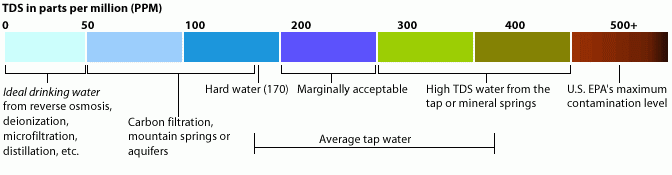
Diagram 1: TDS in ppm
Source: tdsmeter.com/what-is#what
Treating TDS depends on which solids are dissolved in the water:
- If TSD are calcium, magnesium or iron a water softener should be used.
- If concentrations of sodium, chloride, or potassium are elevated reverse osmosis should be used as a water treatment.
- For high to iron, manganese, arsenic concentrations or total hardness in general, other methods should be used.
* TWN Team has written a detailed answer on how to remove As from drinking water. Find it here.
Water softening
Water softening is the removal of metal cations (positively charged ions), such as Ca and Mg, from hard water.
Water softening is usually done by:
Lime softening
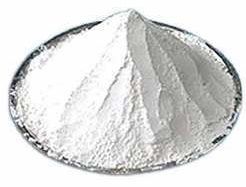

Diagram 2: Lime
Source: limemanufacturer.com/hydrated-limes.html
Lime softening relies on adding limewater (a diluted solution of calcium hydroxide) to make the water softer by removing ions by precipitation.
Pure limewater is clear and colorless, with a slight earthy smell and an alkaline bitter taste of calcium hydroxide. The term lime refers to the alkaline mineral, and is unrelated to the acidic fruit.
A saturated solution of lime has a pH of 12,3.
As lime in the form of limewater is added to raw water, the pH is raised and the equilibrium of carbonate species in the water is shifted. Dissolved carbon dioxide (CO2) is changed into bicarbonate (HCO3-) and then carbonate (CO32-). This action causes calcium carbonate to precipitate due to exceeding the solubility product.
Additionally, magnesium can be precipitated as magnesium hydroxide in a double displacement reaction.
Unlike ion exchange softening, where sodium is exchanged for calcium and magnesium ions, there is a substantial reduction in TDS whereas in ion exchange softening there is no significant change in the level of TDS.
Ion-exchange resins
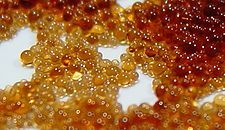

Diagram 3: Ion-exchange resin
Source: en.wikipedia.org/wiki/Ion-exchange_resin
Ion exchange is a physical- chemical process in which ions are swapped between a solution phase and solid resin phase.
Ion exchange resins are ion exchange polymers that are insoluble. They form small beads that are porous (water can pass through them). That way they provide a large surface area.
The process is named due to some ions being trapped and others released.
Ion-exchange resins are used to replace the magnesium and calcium ions in hard water with sodium ions.
Fresh resin contains sodium ions at its active sites. When in contact with a solution containing magnesium and calcium ions (but a low concentration of sodium ions), the magnesium and calcium ions preferentially migrate out of solution to the active sites on the resin, being replaced in solution by sodium ions.
This process reaches equilibrium with a much lower concentration of magnesium and calcium ions in solution than was started with.
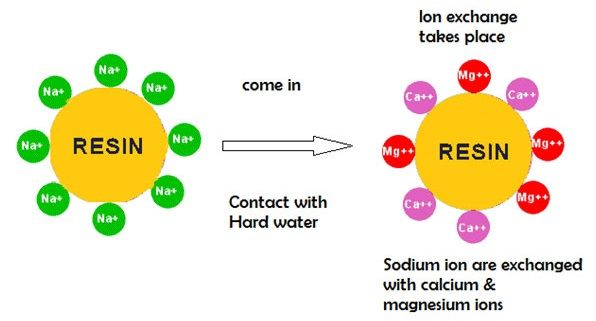
Diagram 4: Ion-exchange
Source: benbellsoftenersystems.in/water-softener/
The resin can be recharged by washing it with a solution containing a high concentration of sodium ions (e.g. large amounts of common salt (NaCl) dissolved in it). The calcium and magnesium ions migrate off the resin, being replaced by sodium ions from the solution until a new equilibrium is reached. The salt is used to recharge an ion-exchange resin which itself is used to soften the water.
Reverse osmosis
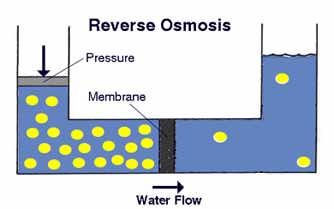

Diagram 5: Reverse Osmosis
Source: tdsmeter.com/what-is?id=0013
Osmosis is a spontaneous movement of the molecules in the solvent through a semi-permeable membrane. The molecules tend to “go” in that direction that will equalize the concentrations of the two sides.
Reverse osmosis (RO) is a process in which the particles move in the opposite direction than in natural osmosis. For this process, pressure is needed – the hydrostatic pressure needs to be greater than the osmotic pressure.
The RO membrane has pores large enough to admit water molecules for passage while ions such as Ca2+ and Mg2+ remain behind and are flushed away by excess water into a drain. The resulting soft water supply is free of hardness ions without any other ions being added.
Membranes have a limited capacity, requiring regular replacement.
Carbon filtration
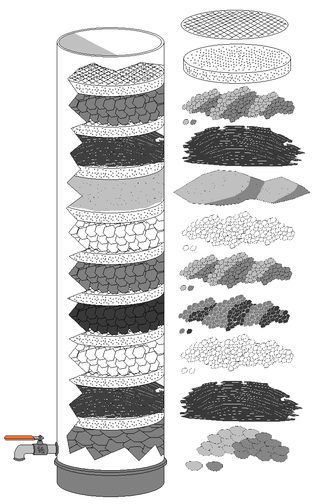

Diagram 6: Activated carbon filtration
Source: en.wikipedia.org/wiki/Carbon_filtering#/media/File:Water_Filtration_Systems.png
Carbon filtering is a method that uses a bed of activated carbon to remove contaminants and impurities, using chemical adsorption (adhesion of atoms, ions, or molecules from a fluid or dissolved solid to a surface).
Activated carbon traps pollutant molecules inside the pore structure of the carbon substrate.
Each particle/granule of carbon provides a large surface area/pore structure, allowing contaminants the maximum possible exposure to the active sites within the filter media.
(One pound of activated carbon contains a surface area of approximately 100 acres.)
Because of its molecular makeup, activated carbon can adsorb well, meaning that it can take in or collect many organic molecules on its surface.
Granular activated carbon filters are inexpensive and maintenance involves replacing six to twelve cartridges a year, depending on the quality of the raw water and the filter media.
Active charcoal carbon filters are most effective at removing chlorine, sediment, volatile organic compounds, taste and odor from water. They are not effective at removing minerals, salts, and dissolved inorganic compounds.
Distillation
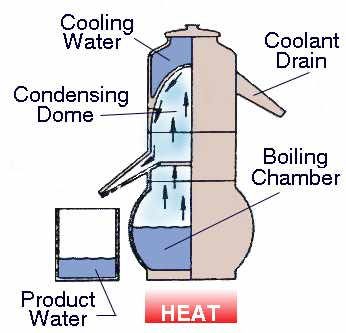

Diagram 7: Distillation
Source: tdsmeter.com/what-is?id=0014
Distillation is a procedure by which the liquid is purified by heating and cooling. It is a process of separating the component or substances from a liquid mixture by selective evaporation and condensation.
It is a physical separation process and not a chemical reaction!
Distillation may result in complete separation (nearly pure components), or it may be a partial separation that increases the concentration of selected components of the mixture.
Deionization
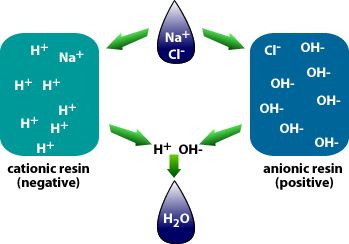

Diagram 8: Deionization
Source: tdsmeter.com/what-is?id=0015
Deionization (DI) is a water filtration process where TDS are removed from water through ion exchange by controlling the electric charge of ions in the water.
The process of deionization uses two resins that are opposite in charges – the cationic (negative) and the anionic (positive).
DI resins attract non-water ions and replace them with water ions:
- The cationic resin will attract the positively charged ions in the water (Ca2+, Mg2+, Na+) and release an equivalent amount of hydrogen (H+) ions.
- The anionic resin will attract the negatively charged ions (HCO3-, Cl-, SO42-) and releases an equivalent amount of hydroxide (OH-).
The hydrogen and hydroxide ions then combine to form water. (H+ + OH- = HOH or H2O.)
A single deionization cycle may not remove all the TDS.
Some of the ions will not be attracted by the resins, so running the DI water through a second cycle will provide additional purification.
Compared to other filtration and purification methods, DI has a relatively short filter cartridge life and once it begins to fail, the TDS level of the purified will “rise” exponentially.
Additional resources:
Detailed TDS and safe water information
WHO Guidelines for drinking-water quality
EPA drinking water standards and health advisories table
Read more related content on total dissolvde solids ( TDS) here.
Related question: What is the best range for TDS in potable water?