The Water Network research ...
Published by Water Network Research, Official research team of The Water Network
The Water Network research team has consolidated an answer to the above question.
Further input from members is welcome and appreciated.
Total Dissolved Solids (TDS) are all the minerals, salts, metals and ions (cations and anions) in the water.
Pure water is a universal solvent – it easily dissolves the inorganic salts (Ca, Mg, Na, bicarbonates, chlorides and sulphates) and some of the organic matter, hence the dissolved solids in water.
The biggest concern for irrigation water quality is salinity. Salts can affect the crop yield and soil structure.
Dissolved solids concentration is often called water’s salinity .
Water salinity is, according to Heath, 1983, classified into:
- fresh, 0-1,000 mg/l;
- slightly saline, 1,000-3,000 mg/l;
- moderately saline, 3,000-10,000 mg/l;
- very saline, 10,000-35,000 mg/l;
- briny, more than 35,000 mg/l.
There are two different problems with dissolved salts in water: total salinity and sodium (from sodium chloride).
The soil salinity will increase and affect the plants as saline water used for irrigation evaporates while the dissolved salts remain.
High sodium and low calcium levels of soil or water make the irrigation less efficient as they reduce the water infiltration rate so not enough water reaches the plant and the growth is reduced.
Mild salt effect can, however, go unnoticed especially due to the uniform growth reduction of plants.
Moreover, the irrigation method depends on the total dissolved solids in the water. For example, drip irrigation is suitable for saline water.
The following guidelines for irrigation water have been successfully used in agriculture.
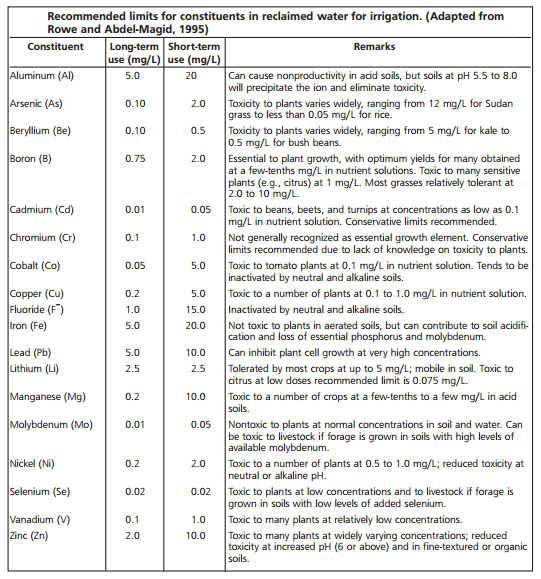
Image: Irrigation water standards
Image source: www.fao.org/docrep/003/T0234E/T0234E01.htm
Methods for overcoming the limitations of irrigation water and analytical procedures for the laboratory determinations are given in several publications:
- USDA Handbook 60 (Richards 1954),
- Rhoades and Clark 1978,
- FAO Soils Bulletin 10 (Dewis and Freitas 1970),
- Standard Methods for Examination of Waters and Wastewaters (APHA 1980).
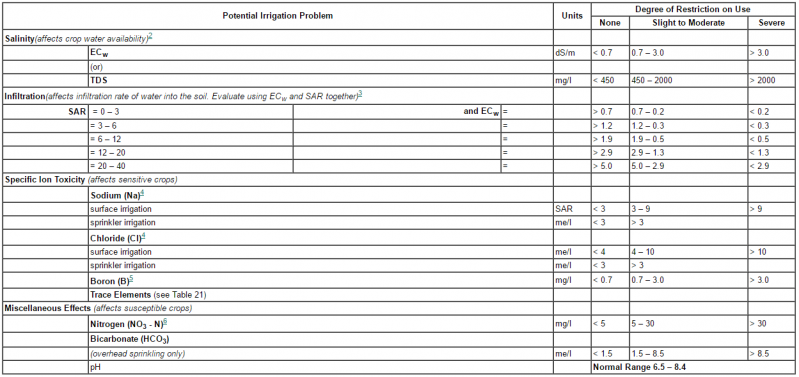
Image: Guidelines for interpretations of water quality for irrigation
1 Adapted from University of California Committee of Consultants 1974.
2 ECw means electrical conductivity, a measure of the water salinity, reported in deciSiemens per metre at 25°C (dS/m) or in units millimhos per centimetre (mmho/cm). Both are equiva-lent. TDS means total dissolved solids, reported in milligrams per litre (mg/l).
3 SAR means sodium adsorption ratio. SAR is sometimes reported by the symbol RNa. See Figure1 for the SAR calculation procedure. At a given SAR, infiltration rate increases as watersalinity increases. Evaluate the potential infiltration problem by SAR as modified by ECw.Adapted from Rhoades 1977, and Oster and Schroer 1979.
4 For surface irrigation, most tree crops and woody plants are sensitive to sodium and chlor-ide; use the values shown. Most annual crops are not sensitive; use the salinity tolerance tables (Tables 4 and 5). For chloride tolerance of selected fruit crops, see Table 14. With overhead sprinkler irrigation and low humidity (< 30 percent), sodium and chloride may be absorbed through the leaves of sensitive crops. For crop sensitivity to absorption, see Tables 18, 19 and 20.
5 For boron tolerances, see Tables 16 and 17.
6 NO3 -N means nitrate nitrogen reported in terms of elemental nitrogen (NH4 -N and Organic-N should be included when wastewater is being tested).
Image source:
www.fao.org/docrep/003/T0234E/T0234E01.htm
Two commonly used methods for removing TDS in irrigation water are reverse osmosis and deionization.
Distilation and electrodialisis produce very pure water but also cost a lot and are, therefore, not the best methods for purifying irrigation water.
Reverse Osmosis
Reverse osmosis (RO) is the most cost-effective water purification method for irrigation.
It removes 95-99% od TDS.
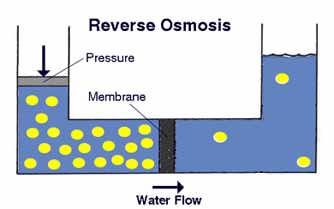
Image: Reverse Osmosis
Image source: www.tdsmeter.com/what-is?id=0013
Osmosis is a spontaneous movement of the molecules in the solvent through a semi- permeable membrane. The molecules tend to “ go” in that direction that will equalize the concentrations of the two sides.
Reverse osmosis (RO) is a process in which the particles move in the opposite direction than in natural osmosis. For this process, pressure is needed – the hydrostatic pressure needs to be greater than the osmotic pressure.
The RO membrane has pores large enough to admit water molecules for passage while ions such as Ca2+ and Mg2+ remain behind and are flushed away by excess water into a drain. The resulting soft water supply is free of hardness ions without any other ions being added.
Membranes have a limited capacity, requiring regular replacement.
The degree of removed salts depends on the RO pressure, membrane, TDS and temperature. Efficiency depends on the membrane cleanliness.
Brine water is a byproduct of RO and it needs to be properly disposed.
Deionization
Deionization is very effective and water produced is of better quality than required for irrigation.
The cost of deionization increases with the amount of TDS is water.
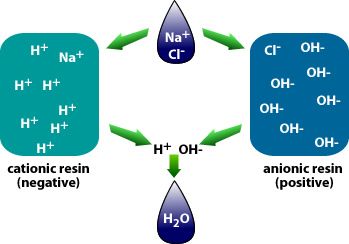
Image: Deionization
Image source: www.tdsmeter.com/what-is?id=0015
Deionization ( DI) is a water filtration process where TDS are removed from water through ion exchange by controlling the electric charge of ions in the water.
The process of deionization uses two resins that are opposite in charges – the cationic ( negative) and the anionic ( positive).
DI resins attract non- water ions and replace them with water ions:
The cationic resin will attract the positively charged ions in the water (Ca2+, Mg2+, Na+) and release an equivalent amount of hydrogen (H+) ions.
The anionic resin will attract the negatively charged ions ( HCO3-, Cl-, SO42-) and releases an equivalent amount of hydroxide (OH-).
The hydrogen and hydroxide ions then combine to form water. (H+ + OH- = HOH or H2O.)
Compared to other filtration and purification methods, DI has a relatively short filter cartridge life and once it begins to fail, the TDS level of the purified will “ rise” exponentially.
Costs of RO is generally 5-6 times lower than of deionization.
We, therefore, suggest RO as the best treatment method for irrigation water on a golf course.
Read about the removal of individual salts in Irrigation Water Quality for Greenhouse Production.
Sources: