How about micro media filter...it might exceed requirements for its filtered water quality as pretreatment. Maybe membrane based prefiltration provides marginally higher water quality for filtrate...micro media filter achieves almost comparable performance at lower cost,with 2 backwashable particulate media layers,aptly designed
Yes, the best filter media is Activated Filter Media. It has 30-80% better performance and a more reliable and consistent filtration than sand confirmed by independent testing. Biofilm and scaling will not occur and hence chemicals are not needed. The media is self-cleaning, self-charging and self-sterilising, therefore it does not need to be cleaned or changed during the lifetime of the filter. The oldest media in operation at the moment is over 20 years and it is expected to last over 30 years.
I am experienced in the use of this product and filtration processes in Asia and Australia. Please email me at andrew@waterandoilsolutions.com.au and I will be happy to provide case studies, referrals, and other literature on the product.
It is very valuable all comments from Mr Voutchkov, one of the worldwide experts in desalination and from Mr. Talavera, with huge experience in desalination too. I invite both to deep in the OPEX improvement with installing ozonization steps in front of coagulation and/or in front of filters (sand, BAC) to break -C=C- and get AOC (assimilable by bacteria) and in case of BAC extends the half-life of activated carbon. UV in front of RO is another alternative if microorganims are efficientelly removed previously.
I strongly support the observations of Dr. Talavera. I have worked on 9 SWRO desalination projects in the Middle East, where they use UF or MF system for pretreatment as a single pretreatment stage and all of them operate at 20 to 30% below their design capacity. UF and MF filtration are excellent (but expensive) technology to remove suspended solids and pathogens but have only disadvantages in terms of reducing the biofouling potential of seawater, brackish water or wastewater. In seawater the main type of fouling is biofouling - seawater bacteria are not pathogens for humans and they do not reduce biofouling - quite the opposite - they accelerate it. As suggested by Dr. Talavera, if you install conventional deep gravity media filter upstream of the existing UF system, the gravity filters will gently remove the algae and bacteria, and if their total media is deeper than 1.8 meters, they will also remove dissolved organics by biofiltration in the bottom third portion of the filter. So you existing UF system will work as expensive back washable cartridge filters and you will need it as such if your existing UF system does not have cartridge filters downstream of it.
Orange County Water District for many years has used MF immediately after secondary treated wastewater and before RO. It works great. They maintain a chloramine residual throughout the system..
Please take in big consideration the response from Mr Voutchkov.
All he says is 100% true.
UF is not a good pre treatment for RO in the most of the cases, producing a high fouling in the RO membranes and a big chemicals and water consumption in the UF section.
The gurus of modernity are wrong when depreciate sand filtration because is an "old system".
I do not know any Plant fitted with UF that is working OK.
All of them have big troubles and also a big consumption of cartridge filters (Normally 4 or 6 times higher than the ones in sand filters Plants)
Ask to the UF makers why their warranty is SDI 2,5 or 3 and not 0,5
Water filtered through a 0,003 microns should not deposit any matter on the Millipore SDI of 0,45 microns, but you get normally SDIs from 1,5 to 3.
The best pre treatment is a double stage sand filtration, with a first stage of anthracite and sand and a second one with sand and garnet.
In your case, I should keep the UF and should install the sand filtration as pre treatment of the UF.
Perhaps in this case, a single stage of dual media filtration should be enough.
Dear Mr. Ali, If your water contains high organic levels - i.e., total organic carbon (TOC) concentration higher than 2 mg/L and it has algae in it, membrane pretreatment will not work well. The problems with membrane pretreatment are not pertinent to Dow's model of UF - membranes - if your source water TOC is higher than 2 mg/L, no membrane pretreatment system available on the market will work well. In this case, the best technology will be deep dual media gravity filter - preferably pumice and sand.
Our plant uses multi-media filters ahead of the RO trains to remove particulates and decrease turbidity. Typical turbidity values on post filter is 0.06 - 0.12 NTU.
Published
by Samuel DeGuzman, Water Treatment Plant Supervisor
Well moving fro UF back to media filters, sound to me like move back in time...try Amiad AMF2 filters...you can check for yourself....find all about this wonder in www.amiad.com
hi, If you really want to remove the UF as pre treatment for whichever reasons, then I suggest you use AFM (Activated Glass media) from Dryden Aqua. With correct design of the system, ie. retention time worked out correctly with their guidelines you can get down to 3 micron, which will be more than adequate to feed the RO. I have personally used this in many small to medium sized RO applications and its works like a dream. Let me know if you need further assistance and I would be happy to design you the correct pre filtration solution. All the best, James Morisse. Cellular no: +27 82 803 1010 or E.Mail me on james@nuwaterglobal.com
There is really is no benefit to be expected for the RO if you replace the UF with media filters if the goal is produce lower turbidity in the RO feed. Dow has a 30micron pore size, and the best media filters could claim 1 to 5 micron effective pore size. Now, your Dow UF should have
If turbidity is high in your RO feed then replacing the UF by a media filter will just make it worse because such filters will barely remove colloids and corresponding turbidity.
After UF at least the turbidity (NTU) should be very low. If not, then it seems that your UF membranes are damaged and need to be replaced. I would recommend to contact Dow.
Hi Mohsan. I agree with many other posters that UF can be effective at reducing much of the load and the ability to flush the UF membranes periodically is also important. If you are finding that the efficiency of the UF membranes is not where you wish to be (in terms of SDI value), you might want to consider using our own patented NanoCeram pleated filters as the final prefilter stage for protecting your RO membranes. Our filters exhibit an SDI value in the 0.5 to 1.0 range and can significantly improve the time intervals for cleaning the membranes. I've attached a file that might be helpful.
Would you please send details of your NanCeram Pleated Filters, as claimed by you, these can replace UF ? and bring down the SDI to a level 0.5 - 1.0? Please send details on
you can substantially reduce down suspended solid load on RO plant by using lower micron pre Filtration. We can provide pre Filtration up to 10 micron through self cleaning automatic screen or disc technology. For more details you can visit www.amiadindia.com or call at +91 9370199188
Coagulation-floculation in front of UF to increase the size of particle could be a solution to reduce turbidity.
Note that UF will not remove dissolved organic material so, Assimilable organic carbon, AOC, and others aliphatic hidrocarbon chains will pass through the membrane, besides this UF isn't a true dissinfection system (although reduce the microorganims level), it means that bio-fouling could appear on your RO membranes after UF.
As an ozone treatment expert I think that a typical DWTP in front of RO membranes is a good solution, so, DAF (for algae removal and bloom barrier) - sand filtration and for dissolved organic material and dissinfection - O3+BAC+UV in front of the cartridge filter + RO.
a Pre-oxidation step will be required for metals removal as iron.
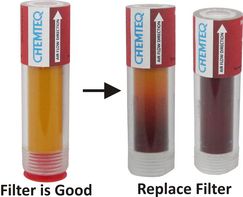
If you do decide to change to media filtration we manufacture filter replacement indicators that are low maintenance and cost effective. The great way to prevent premature filter change or avoid an oversaturated filter. The indicators change color real-time when the filter is saturated. Attached is the indicator and our website for more information. You can contact me if you have anymore questions. Thanks!
.jpg)