We are running a WASH project which is suffering hugely due to lack of water supply.
I ask Water Network members for your advice on simple technological innovations to treat the contaminated water from the river source for urban needs, without having a river plant.
Which simple and affordable technologies can we implement to treat river water both for drinking and municipal use?
French l'eau de rivière est souillée par de nombreuses pollutions dont une grande partie, dissoute dans l'eau, est invisible. il est donc impossible de trouver un dispositif d'épuration aussi efficace soit-il qui sera tgrès onéreux de produire une eau consommable. La anture met des années à produire une eau potable chargée en éléments nécessaires pour le développement du Vivant sur terre. produire une eau vide n'apportera rien à la personne qui va la boire, pire mettra sa vie en danger.
Les eaux de rivière ont un but: se déverser dans un milieu hydraulique naturel chargée d'aluvions. la détourner de cette voie provoquera un déséquilibre biologique de l'écosystème de notre environnement. c'est le cas de la désalinisation de l'eau de mer
Pour ce genre de proposition, il vaut mieux utiliser les eaux usées après qu'elles aient subies un traitement d'épuration comme il se doit.
English
river water is contaminated by numerous pollutions, a large part of which, dissolved in water, is invisible. it is therefore impossible to find a purification device as efficient as it may be, which will be very expensive to produce consumable water. The Anture takes years to produce drinking water loaded with elements necessary for the development of the living on earth. producing empty water will not bring anything to the person who is going to drink it, worse will be life threatening.
River waters have a purpose: to flow into a natural hydraulic medium charged with aluvions. diverting it from this path will cause a biological imbalance in the ecosystem of our environment. this is the case with the desalination of sea water
For this kind of proposal, it is better to use the wastewater after it has undergone a treatment of purification as it should.
We have developed a new technology for river contamination treatment. It doesn't need electricity. Please send some details of your project we can guide an appropriate and cost-effective solution of your problem.
Can you describe the WASH project a little bit? Where is it, what is the climate? Why would you want to use polluted river water as a source of water for instance? What is the type of pollution? Is there any possibility to use any other source for potable purposes, e.g. rainwater? Can you introduce UDDTs in order to avoid using water for excreta transport and ultimately most likely further pollute the river? Can you treat the river water to service water quality for laundry and other household purposes (what are other "municipal" water uses?), e.g. in a wetland, which can be implemented at low external cost, most of the investment being work that can be provided locally?
Also think of closing loops, both water and substances from households, especially nitrogen, phosphorus and carbon, even in very decentralised small treatments for households or buildings. Here, too, wetlands can play a role, e.g. wetlands built in small plastic containers of 1 m³ or so to recycle the laundry water. A friend and colleague in India uses the treated water to water his paddy fields on the terrace of his house, which provide 3 harvest and enough rice for a household of three.
Please note that this approach to treatment is simply by gravity on the presumption that the plant to which you refer would require electricity and chemicals.
this is a short video on a river clean upon Ningbo, China. done very cheaply by a contractor using biocleaner units. the water is crystal clear and they saved a lot of money.
as the water is clear, it allows sunlight to penetrate to the bottom of this river and thus photosynthesis can happen and aquatic plants can thrive. this is a good first step in reviving the ecosystem.
I can confirm that this is a good method of river clean up. The device we use produces 5kg O2 per hour (indepedent testing by University of Southern Queensland in Australia can confirm this) compared to the 3.65 kg O2 per hour of the biocleaner.
I am happy to send videos of the unit working in a Chinese river contaminated by industrial waste and price if you are interested in a cost comparison.
hi Andrew, the 3.6 kgs per hour is for the aeration in a sewage plant. . the unit is only 2 hp.
but we use facultative microbes and what is nice is that as it mixes in the tank there is aerobic zones and anoxic ones and as long as the microbes are mixed, they can break down cod in a very smooth and energy efficient manner,
more importantly, there is no sludge to waste. no odor. and we do not use gut microbes, we use probiotics so the microbiota in the air is healthier. this new facet of concern for the health of the waste water worker is very important.
Please send me an email with water sample (if available) or an idea of what contaminants in the water need to be treated and what the standard to be met is.
andrew@waterandoilsolutions.com.au
We manufacture and supply a range of innovative technologies for drinking and municipal use in Australia and Asia. A recent project in Australia involves the supply of water to a remote community of 1,000 inhabitants where water from a contaminated river (91 agricultural chemicals) was treated to drinking water quality standards.
Published
by Andrew Tran, Engineer
1 Comment
Andrew Tran ,Thank you for your input and contributions.I am currently working to obtain Ngong River water test results.I will get back to you once I find out about the contents of the water for more advise.
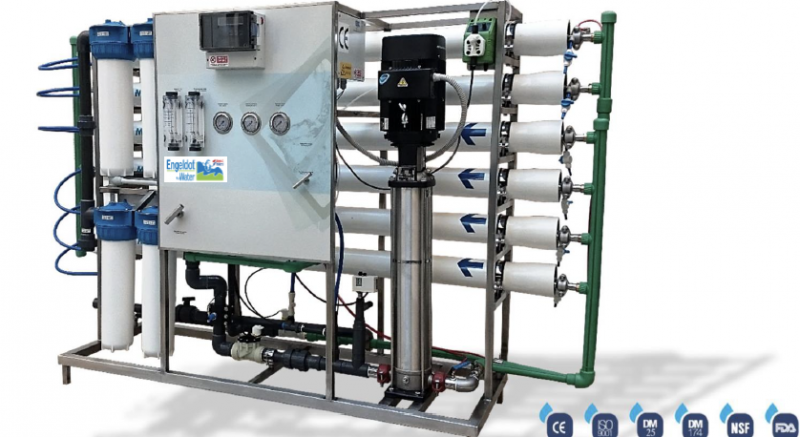
Osmy 3 IN LX are the new water treatment systems with the technology of 'Reverse Osmosis.
There are many applications in water treatment, ideal for medium users such as hotel, food industry, chemical industry or manufacturing. All systems Osmy 3 IN / LX are provided compete with a filter system 20 and 5 micron, metering pump, flow meters, pressure gauges, probes for the conductivity reading. The management of the various functions of Osmy 3 IN / LX is fully automated using dedicated PLC, many possibilities for programming the various stages of operation, all visible through the LCD.
The structure of the system Osmy, is made of stainless steel AISI 304 .
Faire une telle affirmation c'est bien mal connaitre la biologie, la Vie et le Vivant.
MAis non une biodivertsité végétale n'a pas de vocation à épurer les eaux usées. Il absorbera uniquement la pollution diffuse, dissoute, invisible. Tout ce qui est MES restera en l'état.
En outre le végétal ne pouvant rien faire concernant cette pollution diffuse, il va l'absorber jusqu'à saturation et pourrir.
En mourant toute cette pollution retourne dans l'environnement.
Cela ne donne aucune solution fiable. En outre est ce bien normal d'utiliser de la nourriture en abondance quand tant de gens meurent de faim.?
Hello make such an assertion is well know biology, life and living.
But not a plant biodivertsite has no vocation to purify wastewater. It will only absorb pollution diffuse, dissolved, invisible. What is my will remain in the State.
In addition the plant unable to do anything about this pollution broadcasts, it will absorb it until saturation and rot.
By dying all this pollution back into the environment.
This gives no reliable solution. Also is this normal to use food in abundance when so many people are dying of hunger.?
Pl inform where the project is located, the extent and population served, the type of pollutants whether industrial or domestic sewage and whether they are partially treated before disposal by upstream consumers/industries and which river and whether it is major river or a rivulet. This will make it easy to explore solutions.
a very simple way is to limit contamination. stop dirtying it and it will heal....if its difficult to do that... in situ bioaugmentation and adding mixing is very effective and cheap.
We used riverbank filtration in Dandeli, India as primary filtration. Very effective and inexpensive. Presentation and publication links at amandacording.com. Feel free to reach out if you'd like more details on that system.
Amanda Cording will love to learn more and replicate for poor people of INDIA with due recognition and respect to you. regards Biplab T:@BHUNGROO biplabkp@gmail.com
le principe de la filtration c'est de retenir. Tout filtre finit par colmater et une dérivation de la pollution solide passe par ailleurs.
En outre toute la pollution dissoute passe automatiquement c'est plus grave car invisible. Personne n'est en mesure de déterminer les types de pollution qui ont été injectés dans les milieux hydrauliques.
A quoi va servir ce liquide filtré? Si il sert à l'approvisionnement en eau potable alors c'est un crime contre l'humanité.
Hello the principle of filtration is to retain. All filter eventually Plug and a derivation of solid pollution happening also.
In addition all the dissolved pollution automatically it's more serious because we can't see. No one is able to determine the types of pollution that have been injected in hydraulic circles.
What will serve this filtered liquid? If it is used for drinking water supply then it is a crime against humanity.
Life cycle analyses reports reveal membrane filtration system having an edge over conventional designs,particularly when water is scarce and increasingly polluted.
U can also design cheaper membrane systems,and improve thru research
The water at Ngong River at Mukuru is a cocktail of industrial waste water and untreated domestic sewage. Solar desalination/distillation is a feasible option for purification of this highly polluted water. Aquabax offers membrane distillation technology that uses solar thermal collectors.
First you have to address the source pollution and identify the catchments, sources of pollution and causes. Then draw up a detailed action plan with technological options and zero in on the tried and tested, most effective and low life cycle cost (LCC) technologies suitable to the locat2, context and type of influence or waste water characteristics and based on the effluent discharge standards needed based on the end reuse like for agricultural, horticulture, industry etc. Some of the low LCC technologies are SBT, PHYTORID etc.
Dear David, need to know the affluents upriver as well the location of the project. There are very simple way (low cost filtration) that I had implemented in different scenarios in Africa and the southeast Asia... If you can send me the location I'll be able to send you some ideas that I had implemented in the pass...
Send me a mail and I'll send you what documentation I have...
This is a very subjective matter. First you need to identify the water quality of river and accordingly, you can ask what are the innovative technologies available for treatment of your raw water.